Interview with Calliope Jeffers from Donna Schlacter’s Calli

Welcome to Novel PASTimes, Calliope. What can you tell us about yourself?

Calli: Thanks so much. I’m glad to be here. Let me introduce myself. My name is Calliope Jeffers, but everybody calls me Calli. I guess you’d call me the heroine of the story, although that makes me sound so brave, and I’m anything but. You could call me the love interest, but that would be telling the end before the beginning. I’m a recent widow, my husband having died suddenly on duty here where we live in Fort Bridger, Wyoming Territory. I’m stepping out in baby steps, figuring out what comes next.

Novel PASTimes: Okay, Calli. Please tell us something about where you live.

Calli: As I said, Fort Bridger, Wyoming Territory. It’s an exciting time, 1870. There are still wagon trains heading west. Not so many as there used to be, I’m told. The fort is a popular stopping point for supplies, medical care, a blacksmith, and the town itself has several saloons, although I’ve not seen them personally. There are more than a hundred men stationed here, plus a good many civilian employees and military wives. Even a few children.

Novel PASTimes: Do you have a cherished possession?  

Calli: The Bible my parents gave me. When my husband was stationed in Fort Bridger, he said I could bring one suitcase. Can you imagine? How to choose amongst my beautiful dresses, coats, hats, and shoes? But, as he reminded me, we would have nowhere to wear such fripperies, and so there was no point in bringing them. So instead, I filled my suitcase with medical books. And my Bible. It’s the only thing I have from them. I still had room for two dresses, a pair of boots, underclothing (which I won’t mention here), and essentials such as a hairbrush and hair pins.

Novel PASTimes: How do you feel about your occupation? 

Calli:  I love being a nurse. Ever since I was a little girl, I wanted to help people. Of course, back then, boys grew up to be doctors, and girls grew up to be nurses. Perhaps one day, that won’t be true. I do almost all the same things Doc Wheldon would do if he were there, which he often isn’t. And while I can, I still like the personal care of the patient, listening to them, talking to them, writing letters home for them. Most of my patients are soldiers and their wives, both of whom have made a huge sacrifice to serve their country. We should keep them in our prayers.

Novel PASTimes: What is your deepest, most closely held secret? 

Calli:  I struggle with the fact that I loved my husband so deeply that in simply looking at another man, I’m doing both a disservice. Yes, I understand marriage is “til death do us part”, but every time I see Bradley Wilson, I think of my husband. The only thing I can do is trust that God has a plan, and if Mr. Wilson is part of that, then love will come again. How lucky a woman could I be, to love deeply and eternally twice in this life!

Novel PASTimes: Do you have a personal relationship with the Lord? 

Calli:  I thought I did. I mean, I prayed. Read my Bible. Went to church. But when my husband died, I was angry with Him. He could have saved him, couldn’t He? So why wasn’t he worth saving? That’s what I wanted to know. And the platitudes from the women at the fort didn’t help. God needed another angel. Then why didn’t He simply make another like He did with the first of creation? I was certain my husband died because I didn’t have enough faith.

Novel PASTimes: Has it changed? Why? 

Calli:  When I had that tiny baby depending on me, seeing the way she needed me for food, changing her diaper, keeping her safe, I saw what God wanted to have with me. When I didn’t have what she needed, I felt so helpless. I couldn’t depend on somebody else to save us—I had to turn back to God. Knowing I’m a daughter of the King of kings has changed my life.

Novel PASTimes: That makes a big difference, I agree! What do you expect the future will hold for you?  

Calli:  I’m told I shouldn’t give away the end of the story but suffice it to say that now that my relationship with God has deepened, I know He will be with me all the way. Currently, there are several bright opportunities on the horizon, placed there by God, planned by Him especially for me, so whatever happens, it is well with my soul. Hmm. That sounds like another great hymn in the making.

Novel PASTimes: Is there anything else you’d like people to know about you?

Calli:  I’ve learned that the only One I can truly trust in is God. I’m an independent woman, secure in my profession, able to earn a living for myself. When my husband died, I thought, “Well, this is just another chapter in my life. I must move on and do what I need.” But I couldn’t forget my husband. He seemed in my thoughts every day. And when I met Mr. Wilson, I found myself comparing him to my husband. And always falling short. I realized that unless I had a deep and meaningful relationship with God, unless I trusted in His Son Jesus, I would always fall short in God’s eyes, too. So please, if you haven’t surrendered your life to God and your heart to Jesus, do so. It’s simple. Here’s a short prayer: Dear God, I know I’ve ignored You for a long time. But I give my life to You. Do with it what you will. And Jesus, I know you paid the price for my sin. Please forgive me. I will strive to follow you all the days of my life. Amen. Next, tell somebody of your decision, then find a Bible-believing church. If you’d like to share with me, you can contact me at donna AT livebytheword DOT com

***

ABOUT THE BOOK:

Calli works as a nurse with the US Army at Fort Bridger, Wyoming in 1880. When a wagon train full of discouraged emigrants passes through on its way east, a pregnant widow delivers her baby then dies. Bradley Wilson, leading this train, has few options. He asks Calli to travel with them until they find a relative to take the child in St. Joe, Missouri. Calli, drawn to both this dark and quiet man and the child, resists. But when she disappears, he wonders if she’s run away or been kidnapped. Can these two put their pasts behind them and move into a new future together? Or will Calli insist on having things her own way?

BUY CALLI HERE.

ABOUT THE AUTHOR:

A hybrid author, Donna Schlachter writes squeaky clean historical and contemporary suspense. She has been published more than 50 times in books; is a member of several writers groups; facilitates a critique group; teaches writing classes; ghostwrites; edits; and judges in writing contests. She loves history and research, traveling extensively for both. Stay connected so you learn about new releases, preorders, and presales, as well as check out featured authors, book reviews, and a little corner of peace. Plus: Receive a free ebook simply for signing up for our free newsletter at my website!

Donna’s Blog

Previous blog posts at: History Through the Ages and All Bets Are Off.

Facebook and Twitter.

Amazon, Bookbub, and GoodReads.

Etsy online shop of Donna’s original artwork..

Interview with Grace Tonquin from Melanie Dobson’s The Winter Rose

Novel PASTimes: Thank you for joining us, Grace. You’ve had quite a journey in your life.

Grace: I’m grateful for both the ups and downs.

Novel PASTimes: You’re grateful for the downs?

Grace: Those are the times, I think, when I’ve felt God’s presence the most. In the dark seasons while I served in France and then during the even darker years that followed.

Novel PASTimes: You’ve quoted Psalm 27 quite often along the way.

Grace: “The Lord is my light and my salvation; whom shall I fear?” That reminder gave me courage to continue on.

Novel PASTimes: How many children did you and Roland care for in France?

Grace: I’m not certain. The American Friends Service Committee kept the numbers. I was focused on the daily needs of the refugee kids until we realized that we had to get those who remained with us out of France.

Novel PASTimes: How many children did you escort across the mountains?

Grace: Twelve . . . at least we started with twelve. One had to turn back.

Novel PASTimes: I don’t suppose you could tell us who . . .

Grace: That’s not my story to tell.

Novel PASTimes: You are a hero to every one of those kids.

Grace: A servant, my friend. Answering when our Lord calls.

Novel PASTimes: Can you tell us what happened to Charlie?

Grace: His life was a miracle, but I don’t want to spoil the ending of the book.

Novel PASTimes: Fair enough. Could you tell us instead the significance of the winter rose?

Grace: A winter rose can grow wild in the mountains, in the most rugged terrain. It looks fragile but it’s very strong, defying the winds and cold weather with its strength. A winter rose shows beauty and strength, I think, in the hardest of circumstances.

Novel PASTimes: Thank you for not giving up on the children in France.

Grace: My husband and I have been blessed beyond what we could have ever imagined in our years together. It’s an honor to share our story.

* * *

ABOUT THE BOOK:

The Winter Rose

In this gripping WWII time-slip novel from the author whose books have been called “propulsive” and a “must-read” (Publishers Weekly), Grace Tonquin is an American Quaker who works tirelessly in Vichy France to rescue Jewish children from the Nazis. After crossing the treacherous Pyrénées, Grace returns home to Oregon with a brother and sister whose parents were lost during the war. Though Grace and her husband love Élias and Marguerite as their own, echoes of Grace’s past and trauma from the Holocaust tear the Tonquin family apart.

More than fifty years after they disappear, Addie Hoult arrives at Tonquin Lake, hoping to find the Tonquin family. For Addie, the mystery is a matter of life and death for her beloved mentor Charlie, who is battling a genetic disease. Though Charlie refuses to discuss his ties to the elusive Tonquins, finding them is the only way to save his life and mend the wounds from his broken past.

ABOUT THE AUTHOR:

Melanie Dobson is the award-winning author of more than twenty historical romance, suspense, and time-slip novels, including her latest, The Winter Rose. Five of her novels have won Carol Awards; Catching the Wind and Memories of Glass were nominated for a Christy Award in the historical fiction category; Catching the Wind won an Audie Award in the inspirational fiction category; and The Black Cloister won the Foreword magazine Religious Fiction Book of the Year. Melanie is the former corporate publicity manager at Focus on the Family and owner of the publicity firm Dobson Media Group. When she isn’t writing, Melanie enjoys teaching both writing and public relations classes. Melanie and her husband, Jon, have two daughters and live near Portland, Oregon. Visit Melanie online at melaniedobson.com.

Book Review: Bluebird by Genevieve Graham

 Simon & Schuster (April 5, 2022)

This novel opens in WWI with Adele Savard, a nurse from Canada, who is treating injured soldiers. She meets Corporal Jeremiah Bailey of the 1st Canadian Tunnelling Company and they make an immediate connection. They are both from the same town. Adele and her fellow nursing sisters are nicknamed Bluebirds from the color of their uniforms, thus the title of the book. Jerry goes back to the front and they aren’t sure they’ll see each other again, but they hope to. After the war Jerry and his brother return home to discover their parents have died from Spanish Flu. It’s Prohibition and everyone in town, including Jerry’s late father, have been making money rumrunning. Adele works for a local doctor and she and Jerry reunite after he saves her from his devious rival, a man he has a history with since childhood.

Their romance is tender and sweet, and best of all in my opinion, it is not rushed. They form a friendship that blooms with time.

The story contains a present day thread in which a young woman named Cassie is a historian who used to live in the Bailey House but lost her mother there in an accident. When the current owner finds bottles of whiskey hidden in the walls of the house, the two work to unfold the mystery, which is part of Cassie’s family history. I love family history connections!

I found the modern thread to be brief and while interesting, not too well developed. However, the story of Adele and Jerry is compelling and I love a book that teaches me history I wasn’t aware of. The rumrunning in Windsor, Canada was linked to the US due to its proximity to the border across the Detroit River and the fact that Prohibition ended in Canada long before it did in the US. (The author’s note at the end is not to be missed!)

The story is gritty at times, but just enough to draw you into the story. It involves two bloody periods in history after all. The ending is quite intense, but the conclusion unveils hope and illustrates how those who lived it endured and continued to live their lives. Those who love history, like all of our readers on this blog, will enjoy this one.

I received an advance copy from the publisher for the purpose of review and all opinions are my own.

Reviewed by Cindy Thomson

www.cindyswriting.com

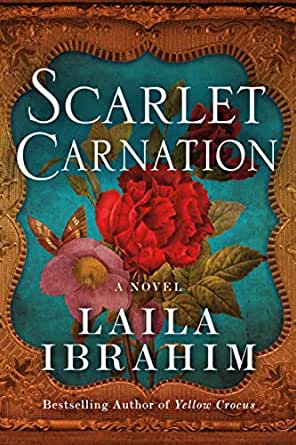
Laila Ibrahim interviews her characters from Scarlet Carnation

Laila: I’m so glad we get to continue our conversation from Women Writers, Women’s Books.

Naomi: Us too!

Laila: Many readers have noticed that the time you lived in parallels current times because there was such an upheaval during World War 1, and the 1918 flu pandemic.

May:  Oh, dear! Did you say World War 1? Does that mean there are more?

Laila: Oh my goodness! I’m so sorry to give away information about your future. Yes, there is another great war that impacts so much of the world; the second one included Asia, North Africa and what we now call Oceana and you called Australia.

Naomi: Will we never learn how to live as one people in peace and with justice?

Laila: My understanding is that fewer people die from warfare, hunger, and disease than ever before in human history. So in some ways we have learned to live with more peace and more justice. But we are far from a goal to have 100% peace and 100% justice.

May: Until this moment I thought I’d like to know about the future, to better prepare, but suddenly I see the disadvantage.

Naomi: If we are honest with ourselves we always know there will be difficult times ahead. Whether those challenges are personal or societal, to be human we must face change, loss and uncertainty.

Laila: Do either of you have any wisdom about adapting?

May: I can pass on the best wisdom from my grandmother. She said we humans are all more like the wizard behind the curtain in the Wizard of Oz, pretending we know what we are doing. She always told me to take the time to listen to my still small voice—she says it’s the spirit of God. 

Naomi: Be kind. To yourself and to everyone around you. Kindness does not cost you anything. If you can’t be kind, take a nap.

Laila: Sometimes I fear that I come across as too serious or only focusing on the painful. What do you do to be in touch with the joy of life?

Naomi:  Being with a baby or little one always raises my spirits. It’s hard to believe this life isn’t a blessing when you are around the wonder and joy of a small child.

May: Each day I look for something beautiful to be grateful for: a flower, my children, the delicious taste of a peach. This life really is a wonder.

Laila: Now you have given away the future…you have more than one child?

May: Yes I do. But I won’t share more than that. You might just have to write another book to find out what happens to us.

Laila: I think you are right about that.

About the book:

In an early twentieth-century America roiling with racial injustice, class divides, and WWI, two women fight for their dreams in a galvanizing novel by the bestselling author of Golden Poppies.

 May and Naomi are extended family, their grandmothers’ lives inseparably entwined on a Virginia plantation in the volatile time leading up to the Civil War. For both women, the twentieth century promises social transformation and equal opportunity.

May, a young white woman, is on the brink of achieving the independent life she’s dreamed of since childhood. Naomi, a nurse, mother, and leader of the NAACP, has fulfilled her own dearest desire: buying a home for her family. But they both are about to learn that dreams can be destroyed in an instant. May’s future is upended, and she is forced to rely once again on her mother. Meanwhile, the white-majority neighborhood into which Naomi has moved is organizing against her while her sons are away fighting for their country.

 In the tumult of a changing nation, these two women―whose grandmothers survived the Civil War―support each other’s quest for liberation and dignity. Both find the strength to confront injustice and the faith to thrive on their chosen paths.


Author information:

Laila Ibrahim is the bestselling author of Golden Poppies, Paper Wife, Mustard Seed, and Yellow Crocus. She spent much of her career as a preschool director, a birth doula, and a religious educator. That work, coupled with her education in developmental psychology and attachment theory, provided ample fodder for her novels.

She’s a devout Unitarian Universalist, determined to do her part to add a little more love and justice to our beautiful and painful world. She lives with her wonderful wife, Rinda, and two other families in a small cohousing community in Berkeley, California. Her young adult children are her pride and joy.

Laila is blessed to be working full-time as a novelist. When she isn’t writing, she likes to take walks with friends, do jigsaw puzzles, play games, work in the garden, travel, cook, and eat all kinds of delicious food. Visit the author at www.lailaibrahim.com.

Book Review: Count the Nights by Stars by Michelle Shocklee

Affiliate link used. If you purchase through this link we will receive a small commission to help support our blog.

Tyndale House Publishers

978-1-4964-5993-0

This is a very engaging dual-time period novel set in 1897 and 1961. I love historicals I can learn from and this one revealed a lot of Nashville’s history from both time periods. The story revolves around the Maxwell House Hotel. (Yes, like the coffee. I enjoyed this historical tidbit!) The earlier time period is set during the Tennessee Centennial Exposition, which is an interesting historical event to learn about. The later time period looks back to that event through the scrapbook of a resident of the hotel during the decline of the hotel. Both Priscilla from 1897 and Audrey from 1961 learn to step out of their comfort zones to help those in need. The plight of immigrants and the exploitation of young girls who are either desolate or too innocent is one of those needs. Civil rights and the education of special needs kids is another. These things could overwhelm a novel but instead Shocklee explores how her characters choose to respond to the people in peril. The title comes from a proverb one of the characters tells Priscilla.

I won’t share any spoilers but this is a book that I’m glad I read and highly recommend.

Read the first chapter here.

Reviewed by Cindy Thomson

I was given a digital copy (via NetGalley) from the publisher for the purpose of review, but no review was required. This is my honest opinion.

Meet Priscilla and Audrey from Michelle Shocklee’s Count the Nights by Stars

Hello, ladies! Please tell our readers a little about yourselves.

Priscilla: I was born in Chattanooga, Tennessee, seven years after the War between the States ended. My father is in the railroad industry and Mother keeps herself occupied with a full social schedule. They are ever hopeful I’ll marry well and settle down, but I know it will take a very special man to capture my heart. 

Audrey: My family and I live in the Maxwell House Hotel in downtown Nashville where my father is manager. It may sound strange, but I really enjoy living in the old hotel. Did you know it was built before the Civil War? Even though that was over one hundred years ago, it’s still a beautiful place. We’re getting ready for Christmas now, with decorations, cookies, and the Maxwell’s world-famous Christmas Day dinner.

You’ve both spent considerable time at the Maxwell House. If you had to choose one favorite thing about the hotel, what would it be?

Audrey: The lobby. My brother and I used to play hide-and-seek in it while Mom worked the guest services desk. From the lobby, you can also see the grand staircase, which leads to the beautiful mezzanine overlooking the main floor. I’ve often imagined belles in gorgeous ballgowns gliding up and down the marble stairs on their way to the ballroom or out on the town with a handsome escort. 

Priscilla (chuckles): I must admit my favorite thing about the Maxwell has nothing to do with its lovely architecture. My favorite place is the confectionary off the lobby. They have the most delicious peaches and cream. 

I understand the famous Maxwell House coffee is named after the hotel. How did that come about?

Audrey: With my father as manager of the historic hotel, I’ve heard the story dozens of times. Back in the late 1880s, two fellows—Joel Cheek and Roger Nolley Smith—developed a special blend of coffee beans. Cheek gave twenty pounds of the coffee to the food buyer at the Maxwell House Hotel, who agreed to serve it to the guests. When the coffee ran out, the hotel went back to serving their regular blend, but the guests complained. They wanted Cheek’s coffee. The coffee became so popular at the hotel that Cheek and Smith eventually gained permission to name it Maxwell House Coffee. An unverified rumor says President Theodore Roosevelt took a sip of the brew while visiting Nashville and declared it “good to the last drop.” I may be a little biased, but I think it is too.  

Priscilla, what brought you and your family to Nashville?

Priscilla: We came to attend the Tennessee Centennial Exposition. People from all over the world are here to celebrate the state’s 100th birthday. Papa is most proud of the Railway Exhibit, which he declares the best on the fairgrounds. I might have to argue that point, because there are so many fascinating buildings and exhibits. I’m especially fond of the wildly amusing sights of Vanity Fair.

Audrey: Did you ride the giant seesaw and the chute?

Priscilla: I did indeed ride the seesaw, which was thrilling. From the top, you can see well over two miles. But the chute is a water ride that tends to leave everyone rather damp. I decided to save my ten cents and spend it on an Italian gondola ride on Lake Watauga.

Audrey: I wish I could travel back in time to the exposition. I’ve recently visited the Parthenon in Centennial Park and found it utterly fascinating. It must have been quite the sight back in 1897. 

Priscilla: It truly is. The Parthenon and other buildings are so well built, you’d never guess they’re meant to be temporary—built to only last the duration of the exposition. My father says most of them will be torn down once the expo ends in October, so I’m glad to know the Parthenon still stands for visitors to enjoy. 

Audrey: Yes, they rebuilt it with permanent materials in the 1920s. There’s a museum inside. 

What is something each of you would like to accomplish?

Priscilla: I appreciate your question, because I’ve been pondering this very thing for some time now. Although I love my parents and the upbringing they’ve provided me, I want more out of life than dinner parties and keeping a well-appointed house. There are so many people beyond the scope of my sheltered corner of the world that need someone to care about them. I’m just now beginning to discover that we all play a role in offering a helping hand to those in need. To truly see someone for the unique human being they are, created by a loving Father. I’m not entirely certain how to go about fulfilling my part in this whole thing, but I’m eager to begin trying. 

Audrey: I love your answer. That’s exactly how I feel too. I’ve been far too self-centered in the past, and I truly want to become the woman God created me to be, using the gifts he’s given me to serve people. I would especially like to work with children like my brother. Emmett is a very special young man, but sometimes the world doesn’t see him and others like him the way my father and I do. I’d like to change that.

Thank you, ladies! We look forward to reading Count the Nights by Stars and seeing how your stories unfold.


About the book:

Count the Nights by Stars

Count your nights by stars, not shadows. Count your life with smiles, not tears.

1961. After a longtime resident at Nashville’s historic Maxwell House Hotel suffers a debilitating stroke, Audrey Whitfield is tasked with cleaning out the reclusive woman’s rooms. There, she discovers an elaborate scrapbook filled with memorabilia from the Tennessee Centennial Exposition. Love notes on the backs of unmailed postcards inside capture Audrey’s imagination with hints of a forbidden romance . . . and troubling revelations about the disappearance of young women at the exposition. Audrey enlists the help of a handsome hotel guest as she tracks down clues and information about the mysterious “Peaches” and her regrets over one fateful day, nearly sixty-five years earlier.

1897. Outspoken and forward-thinking, Priscilla Nichols isn’t willing to settle for just any man. She’s still holding out hope for love when she meets Luca Moretti on the eve of the Tennessee Centennial Exposition. Charmed by the Italian immigrant’s boldness, Priscilla spends time exploring the wonderous sights of the expo with Luca—until a darkness overshadows the monthslong event. Haunted by a terrible truth, Priscilla and Luca are sent down separate paths as the night’s stars fade into dawn.


Michelle Shocklee is the author of several historical novels including Under the Tulip Tree, a Christy Award finalist. Her work has been included in numerous Chicken Soup for the Soul books, magazines, and blogs. Married to her college sweetheart and the mother of two grown sons, she makes her home in Tennessee, not far from the historical sites she writes about. Visit her online at michelleshocklee.com.

Meet Secret Service Operatives from G.S. Boarman’s One April After the War

Louisville Daily Times reporter submitted this interview with Secret Service operatives Merritt and Argent, aboard a private car on the Marietta & Cincinnati railroad.

REPORTER: Well, gentlemen, how is it that two agents of the general government can rate a private car on this train? 

ARGENT: We are merely guests in this car, accommodations afforded to us by Judge Stallo, in Cincinnati.

REPORTER: You have just recently left Louisville, have you not? Our readers are curious about all your trips to our fair city and especially about all your visits to the Warner farm, outside the city.

MERRITT: We go where we are told and Louisville, being as close as it is to Cincinnati, is becoming more tempting to counterfeiting gangs as a place to circulate their queer and to move it further into the South, using the L&N to do so.

REPORTER: Yes, yes. But these trips out to the Warner farm — what is the allure there?

ARGENT: I hardly think our personal affairs can be of any interest to your readers.

REPORTER: But they are! And I must tell you, the rumors are troubling. Here is your chance to correct them. Miss Warner may be a lunatic, but she is Louisville’s lunatic, and we protect our own.

MERRITT: That is the first rumor that needs correcting: Miss Warner is not a lunatic. She may be a recluse and a little eccentric, but she is as sane as you or I. And I hardly know how I myself might respond to a collection of grief these last few years, as Miss Warner has had to endure.

ARGENT:  What are these troubling rumors?

REPORTER: It is said that you both stay in her home, without benefit of chaperone. You can see how this can be troubling to the better elements of society.

ARGENT: But we are her chaperones. With her brothers and father gone — may they rest in peace — we are keenly aware of her vulnerability. She — and Louisville — need not fear any impropriety from us. We visit her at the request of President Grant, and as representatives of the President, we would hardly take advantage of the situation. And, I might add, as gentlemen the affront to our honor is considerable.

REPORTER:  Yes, that is another rumor whispered in Louisville. What is her connection with Grant?

MERRITT:  Mr. Warner consulted for the President — then General Grant — during the war. Bridges and dams and railroads, that sort of thing. 

ARGENT: There was an earlier connection between the two men. Mr. Warner was a guest teacher or instructor of some kind when President Grant attended West Point. Mr. Warner was a civilian engineer and, of course, President Grant graduated as an engineer from West Point. I am given to understand that a friendship arose between the two and they stayed in touch over the years and General Grant engaged Mr. Warner during the war, as Mr. Merritt has said.

REPORTER: But why does the President send you?

MERRITT: As you know, Miss Warner lives alone and manages the family farm on her own. The President merely likes to know how she is doing and if she needs anything, if there is anything he can help her with.

REPORTER: Surely he could write her or even send telegrams, if that is all there is to it.

ARGENT: Miss Warner is an abysmal correspondent. Many —

MERRITT: All.

ARGENT: Many of the President’s attempts at correspondence go unanswered.

REPORTER: But the expense to send to men, merely to gather intelligence!

ARGENT: It is not intelligence gathering; just a how-do-you-do between acquaintances. And there is no added expense to the general government for these trips. We visit Miss Warner only when our work brings us to Louisville, and when we can spare the time — at our own expense.

REPORTER: And what is your connection to the President? Why does he send you two to look in on Miss Warner?

MERRITT: We merely happened to be at hand. We were wrapping up a counterfeit case in Cincinnati last spring when the request came to us to go to Louisville and request the honor of her accompanying us to see her father’s friend at the White house.

REPORTER: About that trip.  Miss Warner had not been seen in town for over a year, at that time last spring. It is well known that she avoids society in general and, if it weren’t for the occasional need to replenish food stuffs, she would never leave her farm. Yet she left with you — two strangers — and was gone for months. And it was later learned that the first month was spent in merely traveling to Washington City, a trip that would normally take, at most, three days. What took so very long? What happened along the way that caused such a delay?

ARGENT: That would fill a book.

MERRITT: Two books.

REPORTER: I see that I will get nothing more from you today, and I have only room for one column of print. Perhaps I could interview you further at another time.

MERRITT: Another time is always preferable. 


After the death of G. S. Boarman, a great niece cleaned out the old Kentucky family farmhouse and in the attic, amid the rusting coffee mill, the rickety outdated furniture that was still awaiting repairs, and the stacks of vermin-eaten Harper’s Weekly’s and Police Gazette’s, she found a curious box marked simply “M”.

On the kitchen floor, the metal hasps were flipped back and the top pried off. Lying on the top of a very neat and orderly collection of things was a scrapbook and lying loose inside the scrapbook was a note that said simply, “Please finish the story.” The scrapbook itself contained a rough outline of a narrative with sometimes undecipherable glosses and cryptic references to mysterious sources.

From letters and notebooks, ledgers and calendars, train schedules and stockholders’ reports, the story was slowly extracted and pieced together, and the small treasures, carefully wrapped and preserved in the box, took their place in the narrative.

Boarman’s will had already been read, probated, and executed, but the niece, as executrix, felt obligated to fulfill Boarman’s last wish — to breathe life into the long-ago story of a woman who held some importance to Boarman.

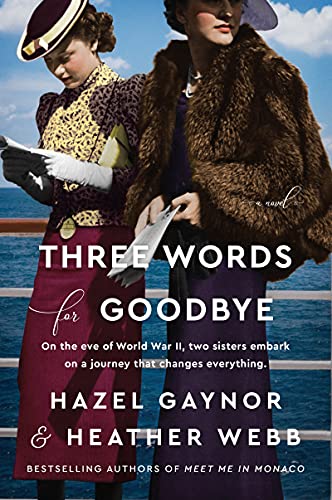
Book Review: Three Words for Goodbye by Hazel Gaynor and Heather Webb

On the eve of World War II, two sisters embark on a journey that changes everything.

William Morrow Paperbacks (July 27, 2021)

Amazon affiliate links may be used. If you purchase through these links our blog will receive a small commission.

In 1937 two estranged sisters are sent by their dying grandmother on a European trip to deliver messages to people from their grandmother’s past. I was transported to Paris, Venice, and Vienna through these pages. The authors are wonderful writers, highly skilled at drawing readers into the times and places they write about. The sisters travel on the Queen Mary, the Orient Express, and the Hindenburg, which indicated that the ending was going to be dramatic. But the inner journey each sister takes is more impactful. They learn what it means to be a family, even when the family looks different from what they imagined.

I liked the format, alternating between each sister’s point of view with a few chapters from their grandmother’s point of view as she waits for their return. The voices were distinct and effective at showing their different personalities and reactions to events. There is a love interest for each sister but the authors do not take the easy way out with either. The sisters do not instantly fall into a man’s arms because of the romantic setting, even though they are told many times it could happen. I love how talented, strong-willed, but not impulsive these characters are. This story explores the importance of relationships in the midst of challenges, dangers, misunderstandings, and mishaps. You’ll enjoy this one!

Review by Cindy Thomson, https://www.cindyswriting

Introducing Buster Wellington from The Road We Took by Cathy A. Lewis

Inspired by her father’s historical recount and stories shared with her during her youth, The Road We Took: Four Days in Germany 1933 is the epic tale of an American Boy Scout who discovers by coincidence four desperate Jewish citizens attempting to escape Nazi Germany.


September 2nd, 1933

Mr. Darcy: Hello Buster! My name is Mr. Darcy, I work for the US Federal Government, Customs Division, and I will conduct your interview today. You’ll have to tell me even before we begin, I see by your passport Buster is not your real birth name. How did you come by that name? And, how old are you?

Buster: Buster is a nickname given to me by my mom, after the barber gave me a Buster Brown haircut. You know, the image of the boy used in advertising to sell shoes? His haircut reminds me of someone putting a bowl over his head and trimming what exceeded the rim of the bowl! And indeed, I had a haircut like that once, at age 3. My father howled with laughter when he saw it. At that point, he started calling me “Buster” and it stuck. My legal given name is Raymond Davis Wellington III. You can see why Buster is so much easier! My age, I just turned 17 three days ago.

Mr. Darcy: As you know, I’m a Customs Agent, and it is my job to interview passengers of the SS Bremen returning from Europe, especially Germany. Our government is interested in what you saw while traveling through. It’s my understanding you spent four days in Germany, is that correct? Can you tell me why you were there to begin with?

Buster: Six weeks ago, my Boy Scout Troop #814 from Rochester, New York began our journey through Europe with our destination being Godollo, Hungary. We were travelling there to attend the 4th Boy Scout World Jamboree. We camped in the Royal Forest on the grounds of the Hungarian Monarch’s estate for two glorious weeks. We camped, fished, played soccer against a number of foreign teams. Thanks to Wolfie, we won all of our matches. He’s a brilliant player. A natural for the sport. Wolfie was one of the best parts of the journey, finding him in Vienna while we were on our way to Godollo.  After the conclusion of the Jamboree, we headed to Germany. The port of Bremen to be exact, where our ship docked, our ship back to the US.

Mr. Darcy: Can you tell me more detail about what you witnessed while in Munich?

Buster: Mr. Darcy, no disrespect meant, but there is only one way to describe what happened in Munich. 

Mr. Darcy: Go on. 

Buster: All hell broke loose. To begin with, after the jamboree, our plan was to first return Wolfie to Munich, his father would be waiting for him. However, when we arrived, that wasn’t the only thing waiting for him. Then to make matters worse, there was a huge parade taking place right in front of our hotel. There were tanks and trucks and thousands of foot soldiers marching.

Mr. Darcy: This is what is of particular interest to me, the parade. Tell me about the troops. According to The Treaty of Versailles, Germany could not re-arm but apparently, the treaty was of no effect. There is one force behind this-Can you tell me who led this armament, who was behind this parade and show of force?

Buster:  That’s easy-Hitler and the Nazis. The troops, the number was astounding. And the way they marched, I believe they call it, “goose-stepping”. With thousands and thousands of troops marching like this, their boot heels hitting the pavement in synchronicity, it sounded like a canon going off with each step. And there were hundreds of tanks, and trucks. My father told me, “It was as if the treaty of Versailles never existed.”  On top of this show of force, there were Nazi Youth, thousands of them, all marching the same way. 

Mr. Darcy: Tell me about the citizens, what was the reaction? Also, this boy Wolfie, was he a German boy?

Buster: Every building hung a Nazi banner, you know, the swastika, and the people lining the streets all had armbands and held flags of the Nazi symbol. It was like they were all in a trance, cheering and shouting in approval, smiling and chanting. Even small children! Like they were drugged. Wolfie was supposed to join the Hitler Youth, it was the law. All boys of a certain age had to quit other groups and join. But he didn’t.

Mr. Darcy: Why not?

Buster: Well, he wanted to remain in the Boy Scouts to attend the Jamboree even though it was forbidden.

Mr. Darcy: We have information that states anyone in opposition to the Nazis, any kind of objector or political adversary, anyone that is Jewish would face severe treatment, even death, did you witness this?

Buster: Oh, yes, yes indeed. It’s difficult for me to discuss. My father can speak of that in detail, you know he works for The State Department as Counsel, right?

Mr. Darcy: Yes, of course we do. Can you tell me one last thing about your journey, sum it all up?

Buster: To begin with, I feel like my eyes have been opened to a hatred I never knew existed. I guess you could say I’ve led a sheltered life up till this point. I’ve never seen brutality such as the kind I witnessed, and not just one incident. It was happening all over Germany, and my father told me about the instances, the events we didn’t see. To think that a man can dictate who can live and who can’t. That a person would have such hatred for Jewish people, the infirmed, anyone that didn’t match the German image and identity astounds me. I can’t understand it. 

Aren’t we all just people, with the same thing running through our veins? This trip made me aware of so many things and I’ve undergone a change as a result. I will now watch out for the younger scouts in my troop, making sure they never have to go through what Ricky and Walter went through. Such life changing abuse. And then, there’s Maddie. Beautiful, gifted Maddie. Because of her, I will never judge a person based on their background, their religion, or any kind of disability. I’ve learned the Nazis murder people that aren’t like them. They want to take over the world and spread their poison throughout the world as we know it. We cannot let that spread or our world as we know it will be destroyed.

Mr. Darcy: Wise words, Buster. This concludes our interview. Your father is next. Thank you.


Cathy has spent over 40 years as a professional chef after graduating from the Culinary Institute of America in New York. She was the first female Executive Chef for the Servico Corporation, where she served The Philadelphia Eagles, The Philadelphia Flyers and The Philadelphia 76’ers. Over the course of her career, Cathy capitalized her creative talents as a restaurant owner and partner, conceptualizing and creating brands for three successful startup businesses, Food Works, in Pittsford, New York, The Bagel Bin in Penfield, New York, and The Nick of Thyme in Brentwood, Tennessee. It was at the Nick of Thyme that Cathy developed long standing relationships within the music industry. Her clients included Donna Summer Sudano, Naomi Judd, Wynonna Judd, numerous Christian and country music artists, world-renowned wine collectors Billy Ray Hearn and Tom Black. After the sale of her business, Cathy cooked for and traveled extensively to movie locations with actress and activist Ashley Judd and her husband, three-time Indy 500 champion Dario Franchitti.  She continues to cook privately for exclusive clients and friends.

When she is not working as a professional chef, she enjoys writing, reading, cooking for her family and special friends, taking photos of nature and food, gardening, watching open wheel racing, watching movie classics from the golden age of cinema on TCM, and chasing her two cats, Princess Poopie Peanut Head and Tout Suite. The Road We Took is Cathy’s first novel and partially conceived from her father’s journal of daily writings and documentations along with the narratives and tales he told Cathy as a young girl. https://www.cathyalewis.com

An Interview with Pignon Scorbion from the novel by Rick Bleiweiss

This article originally appeared in the Morning News in Haxford, England on Thursday, June 30, 1910.

An Interview with Pignon Scorbion By Billy Arthurson

PIGNON SCORBION & THE BARBERSHOP DETECTIVES [Blackstone Publishing; February 8, 2022; hardcover]

Our Chief Police Inspector, Pignon Scorbion, has been in town for just under two fortnights, yet in that short amount of time he has solved three baffling mysteries and apprehended the criminals responsible for those misdeeds. He has achieved near instantaneous recognition and celebrity with Haxford’s residents for both his prowess in solving difficult crimes and for his bespoke colorful linen suits and unique custom-made black and white shoes. I met with him recently to learn more about his background, his methods, and his unconventionality. 

Chief Inspector, you cut quite the arresting figure around town. I wonder if you’d tell me about your attire.

I find that the clothing worn in England in this day and age by the male members of our population is rather tedious and dull, with the hues of the garments they sport being drab and generally uninspired. It is not surprising to me that it is so, as the coloration of mammalian animals in general lack bright colors thereby allowing them to blend into their environment and be less prone to being observed and attacked. I, on the other hand, have no issue at all standing apart from the masses. I welcome being distinguished from the commonplace and the rabble as I find it to be beneficial that the good citizens whose existences that I safeguard can easily detect my presence.

            My suits are fashioned by one of the finest couturiers in our fair land who has precisely followed my instructions to a fault in using only the finest linens and wools, tailoring them to fit me in a manner that leaves little gap between the fabric and my skin, and utilizing colorations that do set me apart when I am out and about. Each pair of the black and white shoes that I have now been sporting for well over two decades are crafted by an exceptional souter in Liverpool whose singular abilities, I am certain, will one day be recognized throughout the land and doubtless beyond the Continent. 

I have at times been referred to as a fashion plate, and I vastly prefer that designation over being described as one who sports dowdy or uninspired clothing. Most fortunately, because of the athletics that I regularly participated in until quite recently, my frame can still support a close-fitting style of a wardrobe without it appearing to be inappropriate for a gentleman of my years.

Where did your tendency to be unconventional stem from?

            That trait that was handed down to me by both my mater and my pater, although more so from the latter. Father did not conform to the norms of his times, and never allowed the scorn or derision of others to influence his decisions or actions. While he was initially ridiculed for the venture that that he initiated in which he hired out dromedaries to those wishing to traverse Egypt’s desert sands, he persevered in his belief that such an enterprise would be profitable and was proven correct. The same can be said for his excursions into the selling of chocolates and sailing from his native country to the lands at the far shores across the Atlantic Ocean. He never embraced the ordinary, nor shirked from taking risks. He was an individualist and through and through.

            Mother was not quite as bold as he, but for all the years that I spent domiciled in their abode, she stressed upon me the importance of one thinking for themselves and espoused the belief that an individual need not conform to the commonplace to succeed in their life. She, like Thelma Smith, attired herself in costumes unlike those that the vast majority of her female contemporaries had clothed themselves in. She implanted in me the beauty of individuality and the richness of expressing the distinctiveness of one’s persona. 

You are obviously quite skilled at detecting and solving complex enigmas. Have you ever been contacted to do so for Scotland Yard, especially now that they are in their new quarters and have expanded their force?

            Rather than residing in our capital city, I much prefer the essence of the English countryside where the air is fresher, the people less jaded, and where I can devote greater attention to fewer crimes. It is in this environment that I am able to have more of an impact on, and truly better safeguard, the residents who I am sworn to protect. Additionally, as you have already observed, I am an individualist, and that is not a trait that sits well with, or is encouraged by, the Met.

            I have been asked to assist, and lend my singular talents in observation and deduction, to investigations that were conducted by the Yard, both when I was but a constable in Chamfield and in my last chief inspector position prior to locating in Haxford, and I did so with productive results in both instances. However, my interest lies in serving the citizens of lesser-populated hamlets and towns than the major metropolises of our country.

            Additionally, having now been reunited with Calvin Brown and greatly enjoying the company of the enchanting Miss Thelma Smith, I am rather pleased with my current situation in this locale, and envision myself remaining here for quite an extended period. After all, where else would I find such an interesting and capable group of associates as assist me in the barbershop?  And, lastly, I would be remiss if I did not also comment on the pleasure I derive from your presence and the support and benefits I receive from your excellent chronicling, Billy Arthurson.

You have mentioned to me in a prior conversation that you regularly travel to London to attend the theatre. What type of performances do you most prefer?

            I have a penchant for ones that contain music, first and foremost. That was fostered on me by my parents, as it was a passion of theirs, and I was initially captivated by that style of theatre by their gift to me on the occasion of my twelfth birthday. They brought me to an early performance of the marvelous HMS Pinafore by W.S. Gilbert and Arthur Sullivan. The music, the scenery, the environment, and the staging were unlike anything I had witnessed up to that point in my life, and it left me with a hunger to have that experience on a more regular basis.

            Since that time, I have attended every major production of the works of Gilbert & Sullivan, with The Mikado, being the one I treasure the most. Others that I cherish are Clarke and Slaughter’s Alice in Wonderland, Monckton and Talbot’s The Arcadians, and The Proflgate, which I attended at the very opening of the Garrick Theatre. I do also attend and enjoy – albeit to a lesser degree – those plays that are bereft of a score, with my singular favorite being The Importance of Being Ernest by that great dramatist, Oscar Wilde. 

Do you keep any animals as pets?

            While I would enjoy the companionship of a foxhound, beagle, or a paisley or bull terrier, the hours I keep, and the daily routine of my position are not conducive to maintaining a tail-wagger. Felines have never truly appealed to me as I possess more than enough independence for one household, and other manner of fish, amphibians or warm-blooded creatures do not inspire me to possess one as an accompaniment to my life. Possibly at such time as I no longer am active on the force, I might consider augmenting my existence and quarters with a four-legged, obedient friend.

When you are not engaged in enforcing our laws, what diversions do you enjoy?

            I do rather enjoy a fine brandy, as does Calvin Brown I might add, and I engage in a game of chess whenever Arnold Hill and I have schedules with matching periods of inactivity – which is much too infrequently. My former spouse, Katherine, provided me with an appreciation of art, especially paintings done in oils, and as a younger lad I was an accomplished hooker in the sport of rugby.  I consume as many books as I am able on as many varied subjects as I can find – and in that regard, Miss Smith’s bookshop is a treasure trove – and lastly, I do particularly relish a well-cooked repast, especially a succulent Yorkshire Pudding and hearty Sunday Roast.


Rick Bleiweiss started his career in music as a rock performer, producer of over fifty records, songwriter, and record company senior executive, and worked with Clive Davis, Melissa Etheridge, the Backstreet Boys, Kiss, U2, Whitney Houston, the BeeGees, and other industry legends  

Since 2006 as a publishing company executive, he has acquired works by bestselling and award-winning authors including James Clavell, Gabriel García Márquez, Rex Pickett, Leon Uris, and Nicholas Sansbury Smith, among others.  

In his latest creative endeavor, Rick has crafted the Pignon Scorbion historical mystery series—blending his love of the past with the twisty deliciousness of a whodunit. 

Follow Rick and Scorbion at www.RickBleiweiss.com