
NOTE: SPOILER ALERT
What follows is the transcript from a radio interview between “KNX-The Voice of Hollywood” arts reporter, G. Raymond Miller, and Harold Dawdry, head of studio relations for Stellar Studios. Mr. Dawdry has held the title for four years. Prior to taking the position, Mr. Dawdry served on the Ohio Film Review Board, one of seven state boards (Florida, Kansas, Maryland, Massachusetts, New York, Ohio, Pennsylvania, and Virginia) charged with reviewing all films and judging their suitability for distribution within their respective states. The interview was conducted on September 8, 1931.
Note: The “/” symbol indicates cross-talk.
GRM: Good afternoon, ladies and gentlemen, I have the great honor of interviewing Harold Tawdry, the vice president/ of—
HD: Dawdry.
GRM: I’m sorry?
HD: Dawdry. I’m Harold Dawdry.
GRM: My apologies, I thought I said that.
HD: Continue.
GRM: Yes, well, I’m here with Harold Dawdry, the vice president of studio relations for Pontiac Productions. Prior to acquiring this position, Mr. Dawdry, you were the junior minister at Grace Episcopal Church in Marietta, Ohio.
HD: That is correct.
GRM: Well, that’s quite the leap from a junior minister in Marietta, Ohio, to the head of studio relations for a large, successful Hollywood production company. How did you get here?
HD: Train. The Sunset Limited. It’s a lovely service/ that—
GRM: Sorry, I was referring more to the professional leap, from minister to studio executive.
HD: Oh, well, yes, that’s the story, isn’t it? Even though I’m only in my early thirties, my career has taken off like an absolute house afire. I had been at Grace Episcopal for only a matter of months when the governor reached out to me, begging me to fill a vacancy on the Ohio Film Review Board. This august committee was charged with overseeing the output of Hollywood.
GRM: Every single film?
HD: Yes. All of them. One reelers, two-reelers, feature films, the whole kit and caboodle. We were vigilant!
GRM: Imagine that. And what were you looking for? What would catch your attention?
HD: Naughty stuff. Kisses that went on interminably. Neck kisses. Shoulder kisses that descended, hand kisses that ascended, that sort of thing. Violence that went unpunished. Gratuitous violence. Gratuitous fanny kicking – the Sennett lot was full of such nonsense. From their films, one might be led to believe that you couldn’t walk down an American boulevard without someone sneaking up behind you and kicking you in the patootie. Such representation of/ mankind—
GRM: Sorry to interrupt, but… we are talking comedy, right? Which is largely based upon the exaggeration of/ human—
HD: Yes, yes. Nobody knows comedy better than me. But, listen… here’s another thing about that Sennett claque – constantly disregarding respect for authority. And, by authority, I am referring to the gendarmes, business leaders, politicians and, yes, ministers. Men of the cloth in particular – we had that stuff taken out right away. Vamoose!
GRM: I see. Uh, if I may push back slightly, Mack Sennett films – the popular Keystone comedies – are well-known and beloved for their comedic and exaggerated physicality. Sounds like you were removing what audiences might feel were their most humorous parts.
HD: You say ‘removing’ I say ‘improving.’
GRM: And, to that point, the Ohio Review Board, along with the other states that had censorship boards—
HD Review boards. We don’t like the word ‘censorship.’
GRM: Review boards… the other state review boards oftentimes went beyond demanding the removal of certain scenes. You also, quite often, demanded changes to the title cards – the dialog cards. So, in effect, you were more than removing material, you were adding to it. Did that seem like, perhaps, moving beyond the scope of your committee’s mission? Beyond title cards, your censo-, uh, your review boards were, in essence, changing the artistic vision of the director and or the scenarist.
HD: What’s your point?
GRM: Okay, let’s move on. You are now working for the studios. Your title is Vice President of Studio Relations. Now that you are, essentially, on the other side of the equation, how do you regard the review boards?
HD: Oh my goodness, don’t get me started. They’re morons! Philistines! You won’t believe what they tell us to cut out of our movies. Tender moments. Punchlines. Dramatic scenes. Why, they’re absolutely tearing apart our dramas. And, for the comedies, they haven’t a funny bone in their bodies – the Midwestern mutts must have buried them all. Which is why I needed to be brought in, of course.
GRM: But, to some of our readers, this might all sound a little bit hypocritical. As a member of the Ohio review board, you were asking for the same type of changes that you are now fighting, no?
HD: Now, wait a minute. My publicist said this would be a puff piece. Let’s get to your puff questions—
GRM: Sir, it must be asked – do you have a moral compass?
HD: I don’t have a compass on me, but I do have a pocket watch and, you know what? My time is up. So sorry if I’m cutting this short but, you know our saying here in Hollywood – time is money! May I close us on one of my favorite Biblical phrases, harkening back to my previous career? “The Lord giveth and the Lord taketh.” Good day.
About the Author:

Glenn R. Miller is the author of the critically acclaimed and award-winning novel Doorman Wanted (“A comic novel that doffs its hat to master humorist P. G. Wodehouse”—Minnesota Star Tribune; “…sly, sophisticated wit…” The Miami Herald) and of the forthcoming novel, Rough Cuts (Fall, 2026). Miller launched his professional career by working on television soap operas and game shows on the back lots of NBC Burbank. He holds a master’s degree from Northwestern University’s Medill School of Journalism and has served as a CBS-affiliate news producer, public television producer, and creative director at production agencies within the Twin Cities.
Book Overview:
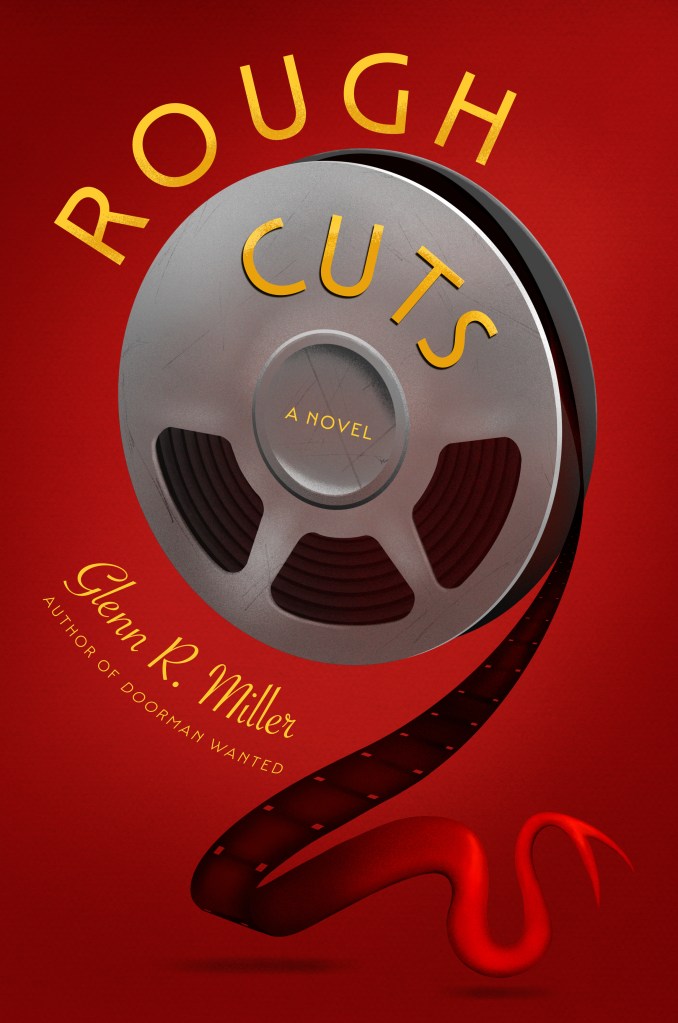
In Rough Cuts, the world of film in 1926 is about to change forever. On the cusp of “talkies,” directors and actors fear their greatest days might soon be behind them. Patrick J. Shepard, a director at the end of his career, has just completed his masterpiece, his vehicle for eternal fame. But there’s one problem: Ohio.
Harold Dawdry, the young, second-string minister at a small church in a corner of Ohio, has been appointed to the State Film Censorship Board. He regards this appointment as his ticket to the power and relevance he desperately craves. There is one director who has particularly rankled his delicate sensibilities: Patrick J. Shepard. The minister feels Ohio is best served if Shepard makes drastic cuts to his final film.
The silent film era is about to get loud.
https://www.amazon.com/Rough-Cuts-Glenn-R-Miller/dp/B0GXNDYXSV
Bookshop: https://bookshop.org/p/books/rough-cuts/388b5b16c8b5f574?ean=9798897470747&next=t
Glenn’s website: https://glenn-r-miller.com/