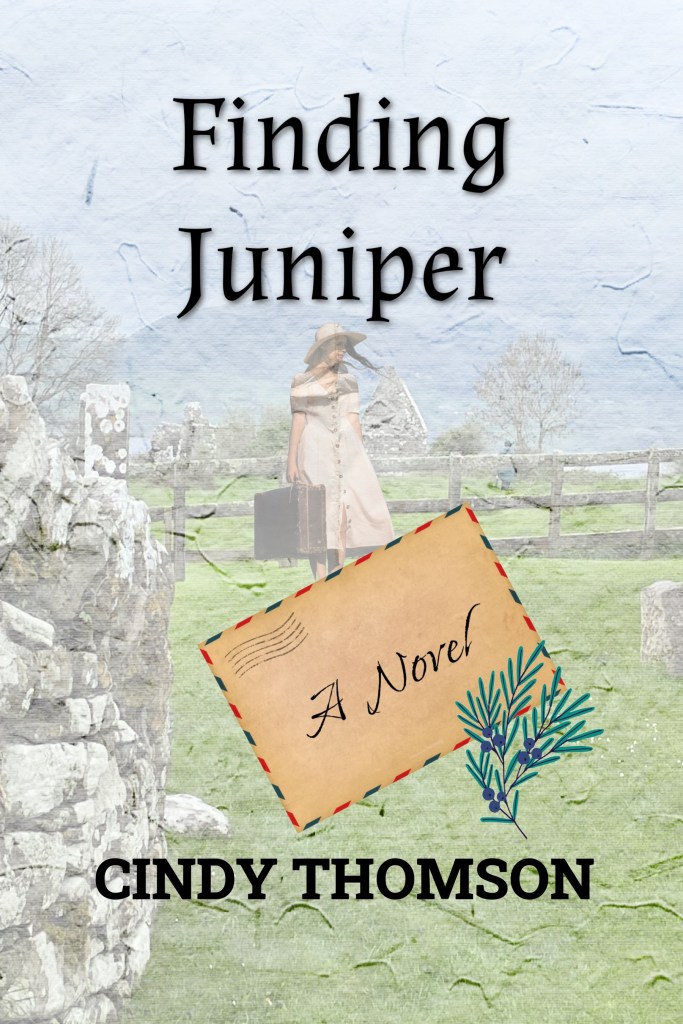
Book Review: Finding Juniper by Cindy Thomson

It’s been a long time since a book brought me to tears, evoking a depth of emotion I rarely experience from reading a novel. Finding Juniper contains that kind of depth.

With the burden of PTSD from WWI and his friend’s rosary in his pocket, Patrick Doyle is summoned to once again confront his past by a cryptic letter that appears to have been written by a child—the long-lost child he’d never known and assumed dead—his daughter, Juniper. 

Caught between two sides of a civil war, Patrick had emigrated to the United States and after much trial, began to rebuild his world with a new family. Shortly after experiencing the loss of his wife, his American daughter, Mardell, beseeches him to travel to his homeland with her and find out what happened to her half-sister, Juniper. Patrick reluctantly embarks on a journey across the pond which stirs up both good and bad memories. 

Author Thomson skillfully weaves Patrick’s reminiscences from the war and life in Ireland alongside Juniper’s journey from life in institutions to that of an independent young woman with questions about the father she never knew and the mother she believes is dead. Following a timeline from 1920 to post WWII, readers will hope and cheer for the characters’ paths to finally meet and may even shed a tear along the way. 

With a balance of Irish melancholy and humor, the author paints a lovely picture of the countryside in Northern Ireland. She shows the culture of superstitious villagers and the kindness of a few towards Juniper and other outsiders through the struggles of post WWII deprivation. 

Finding Juniper is a story of healing family rifts and truth overcoming lies. The truth of the past is brought to light for both Patrick and Juniper in unexpected ways, but just as in real life, the journey there is complicated. 

Fans of historical Christian fiction with a non-preachy message of hope and forgiveness will love this story. Five stars! Highly recommend!

I received a free copy of this book from the author in exchange for an honest review. All opinions are my own.

Review posted by Kathleen Rouser. Find her at: kathleenrouser.com

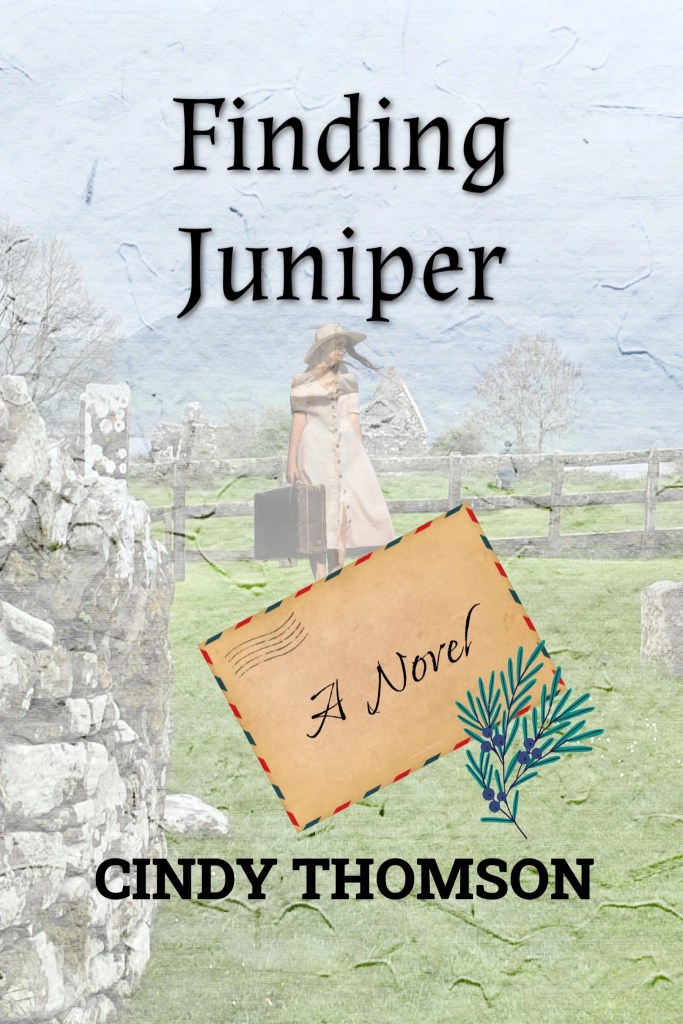
Meet Juniper from Cindy Thomson’s New Novel, Finding Juniper

For Patrick Doyle, the claim that time heals all wounds is a cruel lie.

In 1920, returning from WWI, Paddy finds Ireland creeping toward civil war. Invisible borders separate people, including Paddy and his pregnant girlfriend. With few prospects, Paddy sails to America. However, America is far from the land of opportunity he’d hoped for. And worse, his girl refuses to follow him because of her political involvement.

Thirty years later, Patrick has moved on with his life, building a new family. A letter arrives, suggesting the child he’d assumed died may be alive. Patrick’s American daughter Mardell pushes him to find out what happened to her sister, named Juniper. Patrick anxiously sails to Ireland.

Juniper endured a childhood in institutions, and when she’s released, she moves on without the parents who left her. Operating an apothecary out of an inherited cottage where villagers are slow to trust outsiders, Juniper finally finds a home when her grandmother arrives. Just as she feels comfortable and content, her father shows up at her door, bringing shocking news about her mother.

Finding Juniper invites readers on a journey of confronting the past, healing from old traumas, and redefining what family truly means.


Welcome to the blog, Juniper. Because of the time period of the novel, you might not know what that is.

Juniper: You said this was an interview. Is that what you mean?

Ah, yes, an interview. Readers would like to know about you, especially if they haven’t read the book.

Juniper: [Gasp!] They haven’t read the book? They must or I will cease to exist.

Don’t worry. You’re real to those who have. Tell us something about your childhood. When were you born?

Juniper: Now you sound like those doctors at St. Giles. I was born on the second of June, 1920, in Dublin, Ireland. My childhood was not happy, but you don’t want to hear about that.

Oh, we do! Happy or not, your story will help us get to know you.

Juniper: [Sigh] It won’t really because I’m a new woman, now. But I’ll tell you a wee bit. I grew up without parents, but I wasn’t an orphan. Ireland in those days, well, things were all upside down. My mother got involved in politics. Long story, but she wasn’t in a right state to raise a child. Things are better in Ireland now, in 1950, and I’m doing quite well. When I was young my mother sent me to live with the nuns for a time. I rebelled a bit as a child, so they moved me to St. Giles.

That’s a hospital?

Juniper: Of sorts. So they called it. It was really a place where they put folks, mostly girls, whose families don’t want them or maybe just couldn’t deal with them. They let me go when I was older.

Your parents didn’t want you? I heard a different story.

Juniper: I heard it too. Call it what you will, but in my mind I was abandoned. I’m still trying to adapt.

Say no more. We don’t want to spoil the story.

Juniper: I was happy, though, when I got to work in the gardens. I learned a lot about plants from the gardner at St. Giles. And also from letters my granny sent me. She made herbal cures as well. I am what you might call an herbalist or a natural healer. I think that’s the term from your time.

How fascinating. I bet folks appreciate the things you make.

Juniper: Most do. There was a wee bit of trouble once, a bit of a mix up with one of my cures.

Wait! Don’t tell us.

Juniper: Happy not to talk about that.

So, your father, Patrick, went to America?

Juniper: He did. My mother called him Paddy. I was told he’d died over there.

I heard something different. Life was difficult for him in America. At least in the beginning.

Juniper: Now you wait. Don’t be spoiling things, as you said.

Sorry. Isn’t there a handsome new rector in your village now?

Juniper: Yes, Donal. He’s the kindest person I have ever met. My experience with the church has been less than pleasant, but meeting him has made me look at things differently.

Will something develop between you two?

Juniper: You sound like Granny. We shall see.

Why don’t you tell us about your name?

Juniper: Ah, my name. Granny always called me Juniper, but my birth name was Anna. St. Giles would only call me Anna, so I got used to that. I like Juniper, though, named as I was for a lovely green plant. There is such beauty in the world out of doors. Much healing in plants.

Do you find healing by working in the garden? And in the novel as well?

Juniper: I do feel calmer when I toil in my fields, but healing for my whole self? You’ll have to read to find out.

Thanks for chatting with us, Juniper.


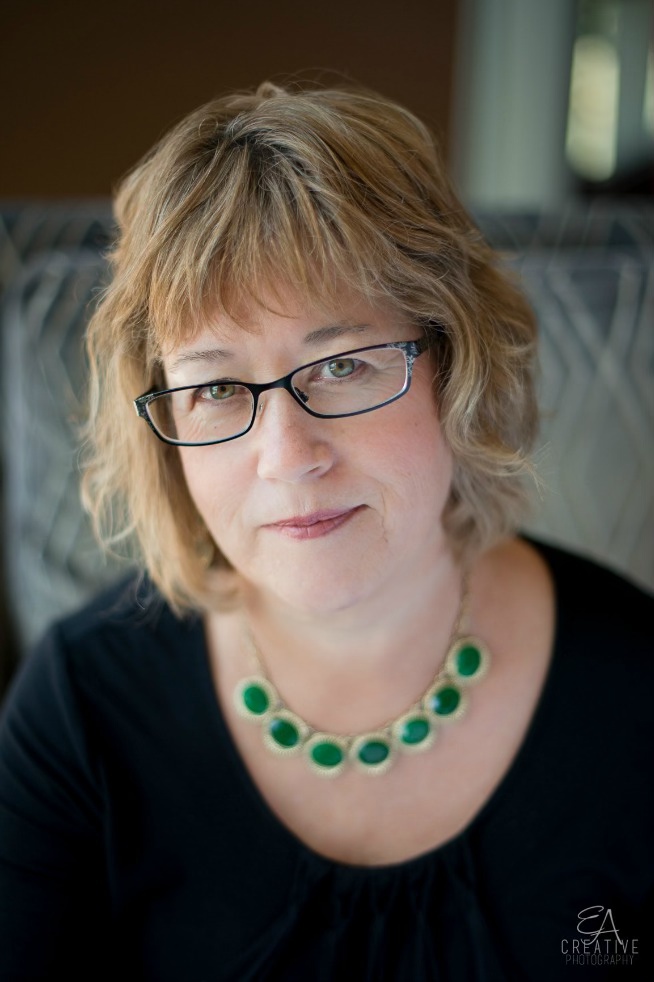
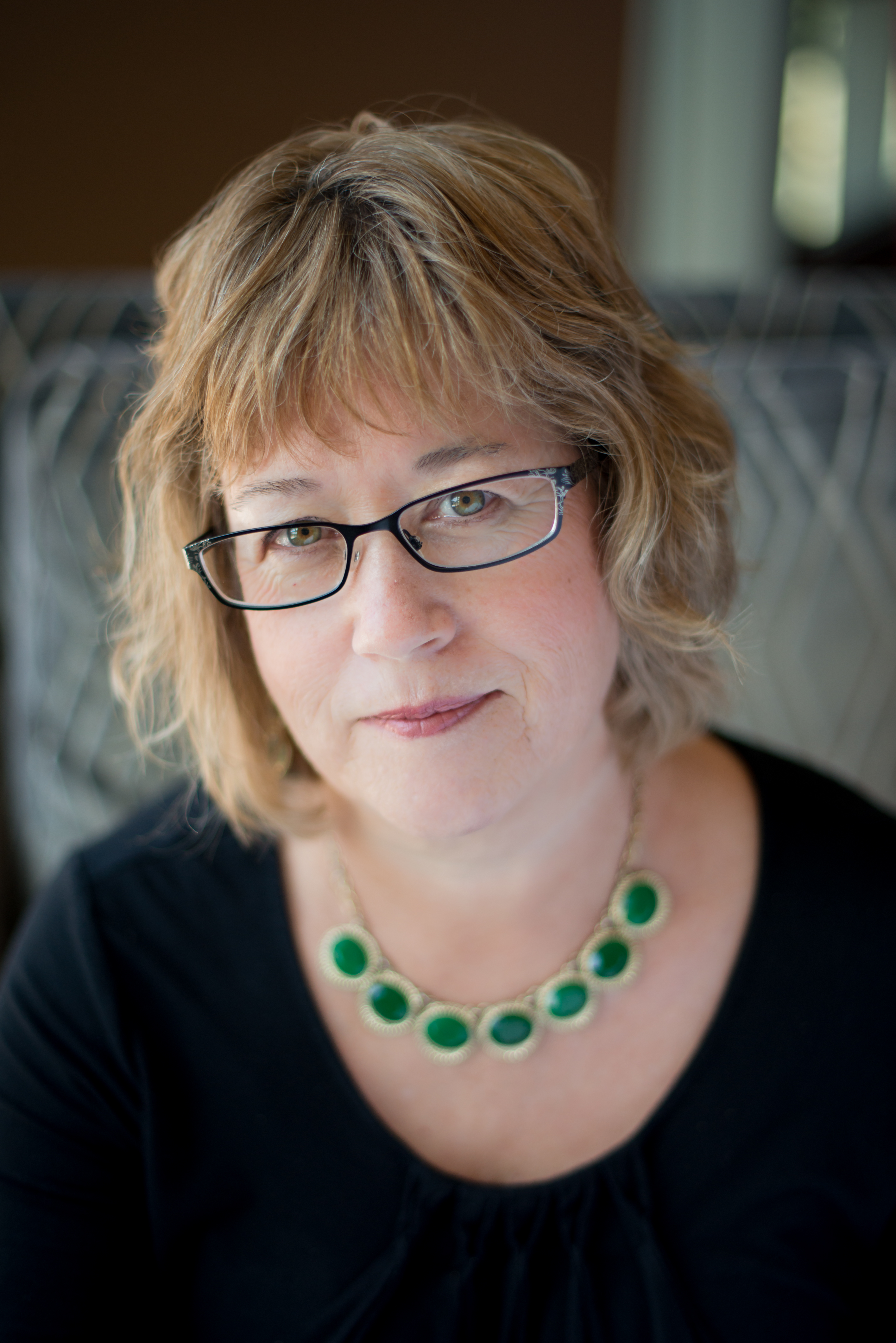
Known for the inspirational Celtic theme employed in most of her books, Cindy Thomson is the author of both fiction and nonfiction. A genealogy enthusiast, she writes from her home in Ohio where she lives with her husband Tom near their three grown sons and their families. Visit her online at CindysWriting.com
Meet Enya from Cindy Thomson’s Enya’s Son

Finally Home LOHello, Enya. I’ve heard this is not the correct spelling. Could you tell us your correct name?


Greetings. It’s my pleasure to speak with you today. My name is Eithne, but my author did not think modern folks would understand my name so she changed it a bit. I really don’t know why. It is pronounced Awn-ya.


Oh, well, that makes sense. You are after all, from the sixth century, aren’t you?


You are correct.


At the beginning of the story, your author mentions a Bible verse from 1 Samuel: I am a woman who is deeply troubled. Was that referring to you?


Well, it’s referring to Hannah of the Scriptures, of course. But yes, I was also a woman deeply troubled, and just like Hannah, a priest misunderstood when I was praying. He thought I was drunk or some such thing. I’m not one for whispering or keeping quiet at all.


You were praying for a child, then?


Aye, I was, and God heard my prayer.


Was becoming a mother all you hoped it would be?


(Laughing) I had no idea what an adventure I was in for! My heart never stopped aching for that lad.


Because you sent him to be raised in the church?


That and more. ’Tis a hard thing for a mother to let go, and here in the wild landscape of Ireland anything can happen, and often does.


The plague, for example?


Awful business, that. My son lost his close friend to that pestilence, and I nearly lost my husband Fe to a terrible fever. Life is uncertain in my world.


Tell us about your husband.


Fe is the strongest man I know, and I don’t just mean muscle. He is my rock. It took me a long time to realize what a wonderful blessing God had given me. You see, I came from a family in the south who did not treat me right. They thought I was special because of my birth order.

(Taps finger on chin.) And, I suppose I might be special after all. Not the way they assumed, but special to God. I cannot tell you why. My author is shaking her head at me. Please read my book and find out!


Thank you, Enya. We would like to take a trip to sixth-century Ireland with you in your book!

***

Cindy Thomson is the author of eight books, including her newest novel, Enya’s Son, third in the Daughters of Ireland series based on ancient legends. Being a genealogy enthusiast, she has also written articles for Internet Genealogy and Your Genealogy Today magazines, and children’s short stories for Clubhouse Magazine. She has also co-authored a baseball biography. Most everything she writes reflects her belief that history has stories to teach. Cindy and her husband live in central Ohio near their three grown sons and their families, and can be found online at www.cindyswriting.com, on Facebook www.facebook.com/cindyswriting and on Twitter: @cindyswriting.authorphoto4cindy-thomson-LR-3

An Interview with the main character from Annie’s Stories by Cindy Thomson


coverOptions_AnnieStories_110113.pdfAnnie’s Stories tells the story of Annie Gallagher, an immigrant from Ireland. We first met Annie in Grace’s Pictures, the first book in the Ellis Island Series. Annie is the housekeeper at Hawkins House, a boarding house for new immigrants run by Mrs. Agnes Hawkins.
Annie, can you tell us how you came to work at Hawkins House?

Oh, now, that’s a question that requires a whole novel to explain. But I’ll give you just a bit of it. I had the unfortunate experience of being put in a place called a Magdalene Laundry back in Ireland, and against my will too! I’ll not tell you how I got out, but I was sent to Hawkins House in Manhattan where a woman named Mrs. Hawkins (better known to some of us as the Hawk) set me up as her housekeeper. I was happy to be there, but I wanted more for my new life in America. The stories my father wrote for me turn out to have a part in helping me achieve my goal, and then some!

On the cover you’re holding a copy of L. Frank Baum’s The Wonderful Wizard of Oz. Can you tell us why? I mean, it is a children’s book.

Then perhaps you’ve not read it? The book is a wonder for several reasons. I was drawn to the story because Dorothy Gale feels neglected by her aunt and uncle, and everything in Kansas is so gray and unwelcoming. She wants excitement. And she certainly gets that in Oz. I know what it’s like to feel that way. And besides all that, the book is printed in such wonderful colors. I had never seen anything else like it. And as for it being for children, ’tis a well-known fact that Mr. Baum has stated the book will appeal to adults as well as children. I would not be surprised if someone made a stage production out of this story. I’ve read it more than once.

Tell us something about the other characters who appear in Annie’s Stories.

Well, there is Mrs. Hawkins, of course. She’s a kindly soul, but rather mysterious. Readers will learn a lot more about her than they did in Grace’s Pictures. Grace and Owen from the first book in the series are in Annie’s Stories as well. Readers of Grace’s Pictures will remember Reverend Clarke and Mr. Parker. There is a terrible Pinkerton man, although if you want my opinion he should not be around at all. And then my troublesome cousin Aileen comes through Ellis Island from Ireland, like I did except not from the laundry. She really should have been the one sent to the laundry, although I would not have wished that on her or anyone. But I’ll let you read about that. We have a new boarder at Hawkins House named Kirsten. She and her perplexing brother Jonas keep us busy. And then there is Stephen Adams the postman. I won’t tell you much about him except that he’s handsome. There are a few other important folks, but you can meet in them in the pages.

I hear that you like to read. Why are books and stories so important to you?

I was raised on stories. My father, God rest his soul, was a seanchai back in Ireland. That’s the word for storyteller. It was his occupation. Stories and the telling of them is my precious link to his memory, and without that I would feel lost. Stephen loves books as well, and he even lives over top of the offices of a publisher. Books feed our souls in a way that no other entertainment can. Wouldn’t you agree?

Thanks so much for chatting with us, Annie. We look forward to your story.

Thank you for inviting me. I hope we meet again in the pages of Annie’s Stories.

About the book:

The year is 1901, the literary sensation The Wonderful Wizard of Oz is taking New York City by storm, and everyone wonders where the next great book will come from. But to Annie Gallagher, stories are more than entertainment—they’re a sweet reminder of her storyteller father. After his death, Annie fled Ireland for the land of dreams, finding work at Hawkins House.

But when a fellow boarder with something to hide is accused of misconduct and authorities threaten to shut down the boardinghouse, Annie fears she may lose her new friends, her housekeeping job . . . and her means of funding her dream: a memorial library to honor her father. Furthermore, the friendly postman shows a little too much interest in Annie—and in her father’s unpublished stories. In fact, he suspects these tales may hold a grand secret.

Though the postman’s intentions seem pure, Annie wants to share her father’s stories on her own terms. Determined to prove herself, Annie must forge her own path to aid her friend and create the future she’s always envisioned . . . where dreams really do come true.

Cindy Thomson is the author of eight books, including her newest novel, Enya’s Son, third in the Daughters of Ireland series based on ancient legends. Annie’s Stories is book two in the Ellis Island Series, published by Tyndale House Publishers. Each book can be read stand alone. Being a genealogy enthusiast, she has also written articles for Internet Genealogyand Your Genealogy Todaymagazines, and children’s short stories for Clubhouse Magazine. She has also co-authored a baseball biography. Most everything she writes reflects her belief that history has stories to teach. Cindy and her husband live in central Ohio near their three grown sons and their families, and can be found online at www.cindyswriting.com, on Facebook www.facebook.com/cindyswritingand on Twitter: @cindyswriting.

authorpiccindy-thomson-HR-2