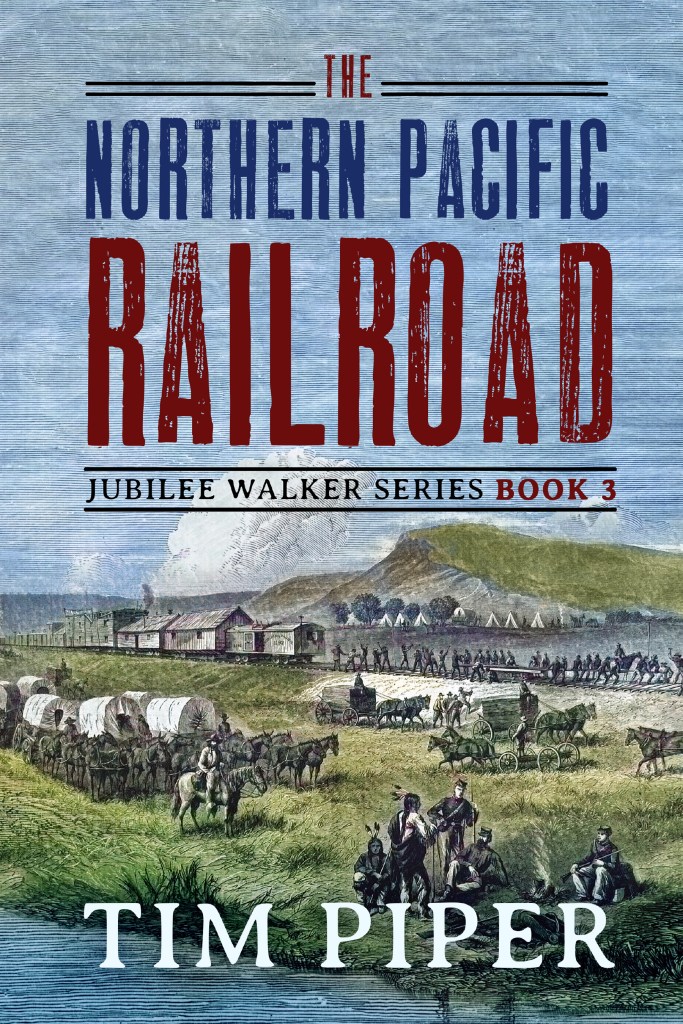
Meet Jay Cooke from Tim Piper’s The Northern Pacific Railroad

Welcome to Novel PASTimes! We are pleased you stopped by today.

Tell us a bit about yourself.

Thank you for inviting me. My name is Jay Cooke, and I was born in 1821, in Sandusky, Ohio, the son of a lawyer who served in Congress. As a young man, I entered the banking business as a clerk and found I had a talent for it. Shortly before the Civil War, I opened my own investment firm, and I was instrumental in selling Treasury notes to the public to finance the Union war effort. Currently, I am heavily committed—personally and through my investment firm—to financing and constructing the Northern Pacific Railroad, a second transcontinental railroad which will connect the Great Lakes at Duluth, Minnesota, with the Pacific Ocean at Puget Sound.

How did you become acquainted with Jubilee Walker?

Nathaniel Langford, a banker and businessman from Helena, Montana Territory, approached me about sponsoring an expedition to explore the uncharted area of the Yellowstone River during the summer of 1870. He believed, and rightly so, that if the expedition proved that the folktales about the region’s unique geography were true, many tourists would be attracted to the area, and they would be anxious to see my railroad completed to carry them there. One of the members of that Yellowstone expedition was Jubilee Walker. Mr. Langford spoke highly of his service and expertise.

When that expedition proved that the rumors about Yellowstone were, indeed, true, an official government survey was launched in the summer of 1871. Jubilee Walker was hired by General Sherman to guide the army engineering contingent sent on that survey.

Then in 1872, a bill was placed before Congress proposing that the Yellowstone region be designated as the nation’s first national park. Jubilee Walker came to Washington, DC, to help lobby for the passage of that bill. I heard great things about young Mr. Walker’s performance on these expeditions, and I thought he might be of further assistance to me. While he was in Washington, I arranged a meeting with my personal secretary, who invited him to come meet me at my home in Philadelphia. 

Mr. Walker graciously accepted my invitation, and, soon after the passage of the park bill, he came to Ogantz, my estate in Philadelphia, for our first meeting.

What is the nature of your business agreement with Mr. Walker?

There are many challenges we face in the construction of the railroad, primary among them funding the effort through to completion. The expense is too great for any single investor, so the project must be financed through the sale of bonds to the public. The public’s willingness to buy those bonds is heavily dependent on the faith they have that our efforts to build the railroad will succeed, and that their investment will bring the returns promised.

The faith those investors have in our success is based on information they read in the news and the credibility of those delivering the message. Though I enjoy a generally favorable public reputation, it is natural for people to look for recommendations from those with less personal interest in the railroad than myself.

This is the role that Jubilee Walker can fulfill for me—offering his personal opinion of the soundness of the idea to build the Northern Pacific Railroad and expressing his confidence that the project can be completed successfully.

I have agreed to make a substantial investment in Mr. Walker’s adventure tourism business upon successful completion of a railroad survey to finalize the railroad’s route. In return, Mr. Walker has agreed to join the survey as my personal representative. As such, he will publicly promote and support the railroad.

What is the greatest obstacle to the completion of the railroad?

The railroad’s exact route has yet to be established across the six hundred miles between Bismarck, Dakota Territory, and Bozeman, Montana Territory. Two surveys are planned for the summer of 1872: One crew will start in Bismarck and proceed west. The other will start in Bozeman and work their way east to meet the westbound crew. Mr. Walker will join the eastbound crew departing from Bozeman.

Unfortunately, the railroad’s route must pass through the traditional hunting grounds of the Sioux tribes. Their leaders have expressed their displeasure with this plan and threatened to retaliate. The army will protect the survey crews, and hopefully no serious incidents will occur. A long-term resolution must be reached, but negotiating with the tribes is the government’s business, not mine.

My concern is that public opinion may turn negative regarding the safety of traveling on a railroad which runs through hostile territory. If the public loses faith that the route can be made safe, they will no longer invest in the railroad’s completion, and the whole enterprise will fail. I am confident that, with Jubilee Walker championing our cause, we will enjoy widespread public support for the project through its completion.

What consequences do you foresee if the railroad survey fails?

America will lose the opportunity to have a critical lifeline tying her coasts together, and our Canadian neighbors will likely capitalize on our failure.

A substantial portion of my personal wealth and the wealth of my investment house are committed to this effort. If the railroad cannot be built to generate the revenue to retire the bonds and pay the investors’ returns, that will severely challenge my ability to meet my debt obligations.

Mr. Walker also has placed his reputation and a significant portion of his personal assets at risk, to ensure that he is committed to a positive outcome on our mutual behalf. And he will be putting his personal safety at risk by facing whatever dangers the survey crew may encounter.
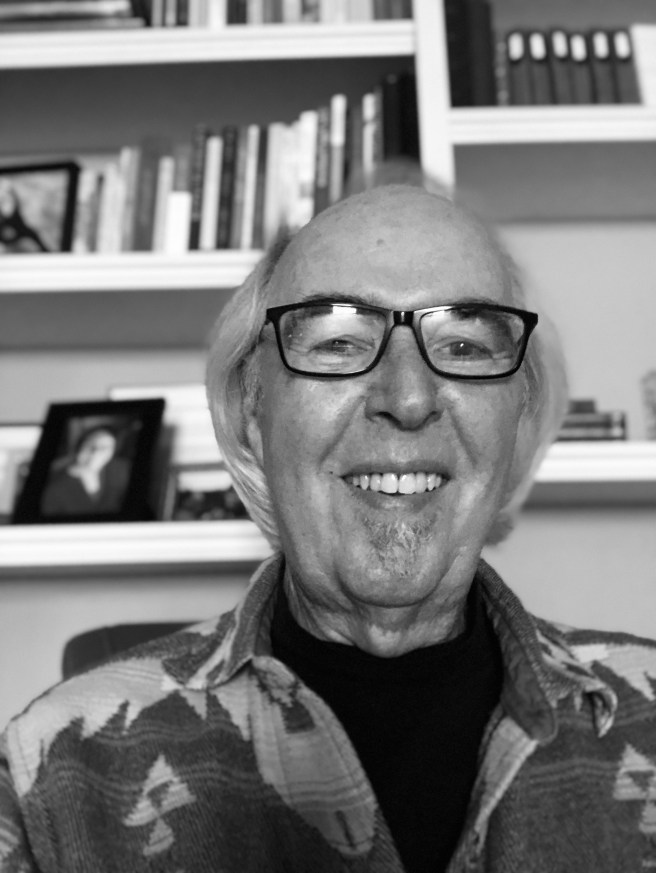

TIM PIPER is retired from a long career in Information Technology and has been a lifelong hobbyist musician. In his earlier days he was an avid hiker and backcountry camper, but his adventures these days are less strenuous and more comfortable. He began his education at Illinois State University as an English major, but life circumstances put him on a more pragmatic path, and he graduated with a BS in Business Admin, a degree he finds appropriately named. He lives in Bloomington, Illinois. 
Learn more at www.timpiper-author.com or follow him on Facebook.

https://timpiper-author.com/

https://www.facebook.com/people/Tim-Piper-Author/61550582340267/?sk=about
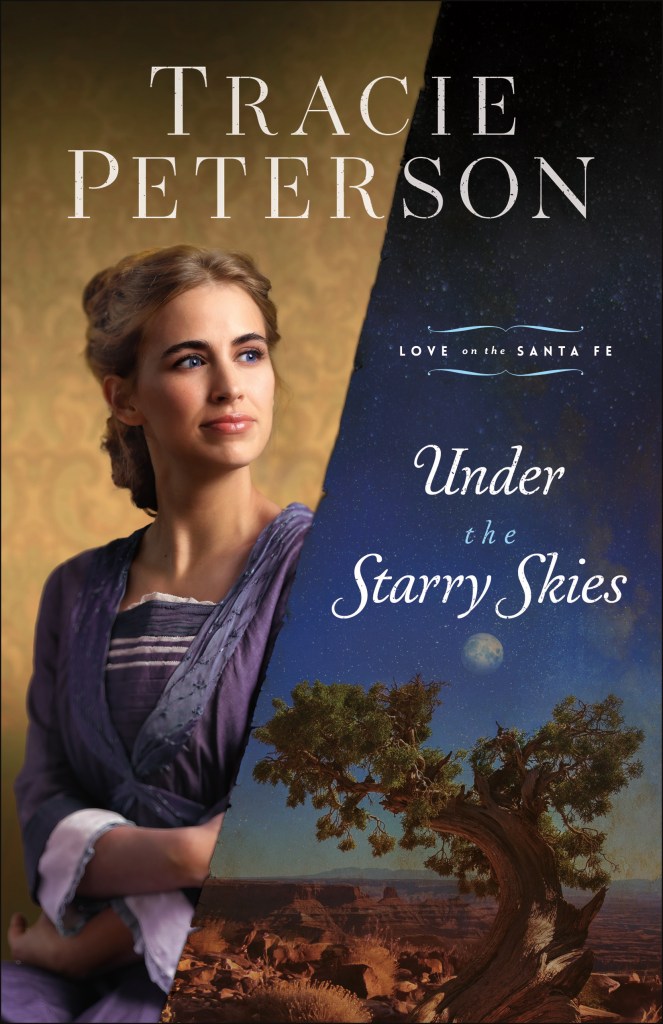
Meet Cassie Barton from Tracie Peterson’s Under the Starry Skies

As an Amazon Associate we earn from qualifying purchases.

My name is Cassandra Barton, but people just call me Cassie.  I live in San Marcial, New Mexico which is on the Rio Grande River.  It’s a hub for the Santa Fe Railroad beings it’s about half way between Topeka and Los Angeles.  I work as a seamstress with the bulk of my work coming in from the railroad men.  I like this kind of work because I am my own boss and can do as much or as little work as I need to do. This turns out to be a very good thing because right off the bat, I break my wrist in a little accident and can’t sew for six weeks.

Brandon Dubarko makes sure I don’t suffer too much. He was a good friend and co-worker of my father’s. He works for the Santa Fe Railroad (just like my father). Brandon is soft-spoken and a deep thinker.  He’s got a world of sorrows to deal with, but he never talks about it. I’m not at all sure what’s weighing him down. I know he really misses my father…and so do I. 

My father died earlier this year when his train derailed. Brandon thinks there was foul play and that someone actually caused the derailment, but I’m not sure that’s the case.  Trains have accidents all the time and it doesn’t take much to derail a train. But, if someone did cause the derailment, then they murdered my father and his fireman.

My father and I were really close, especially after Mother died and my sister Melissa moved to Denver. My deepest desire is that Melissa and I can be close again. After she moved off and married, we aren’t nearly as close as we used to be.  Of course, now she’s a mother and that is bound to take up a lot of her time. 

My future, once my wrist mends, is questionable. A part of me wants to stick around San Marcial, but another part thinks about going to Denver to be closer to Melissa. Of course, at my age (32) I would like to think there was still a chance for romance, but I’m not sure that’s true. It would be a dream come true however, if someone decided I was worth loving.  There was one man…a long time ago.  We were in love and planned to marry, but then my mother died and I needed to care for Melissa.  I don’t know but that it might have been my only chance for love.

I’ve always felt I had to be strong for my family, but now that Mother and Father are dead and Melissa’s married, it’s just me and I’m not real sure what I’m going to do. I know that God has a plan for me, however.  I’ve put my trust in Him since I was little, and I’m not about to stop now. My relationship with the Lord is the thing I value most in life.  He will always see me through.


Award-winning novelist, Tracie Peterson, has been praised for
her captivating historical fiction novels. While each novel weaves
a different tale, Peterson packs her signature elements of history,
action, and romance into each work while also offering
underlying life lessons. In her newest novel, Under the Starry Skies,
Peterson crafts a story about facing your past and learning to
forgive others and yourself.

Meet Carrie Strahorn from Jane Kirkpatrick’s Everything She Didn’t Say

Everything She Didn't Say-Book CoverName:  Carrie Adell Green Strahorn

Parents: Dr. John W and Louisa Babcock Green

Siblings:  Mary Green Waters (older); Hattie Green

Places lived: Too many to mention!  Born in Marengo, IL.  We did have permanent homes for only short times in Omaha, NE; Caldwell, ID and Spokane, WA. But we lived in Denver, Bellingham, San Francisco, Butte, Cheyenne, etc.

Jobs: companion of railroad promoting husband traveling the west to identify locations for the Union Pacific Railroad to bring their tracks to. I wrote articles/letters for newspapers back east and had a pen name of A.Stray.  That’s a story in itself, don’t you think? I also helped start a Presbyterian church which was the work of my life.

Friends: My husband Robert and my sisters are my closest friends. It’s very hard to have long-term friendships when one travels all over the west by stage and train. Friendships take time and commitment. I am committed to helping my husband in his efforts.

Enemies: I don’t have any unless you identify some of the town fathers who disliked my husband because the railroad didn’t come to their town. I’m also my own worst enemy – my self-doubt desire not to disappoint Robert. I always go along with what he wants and that isn’t always wise.

Dating, marriage: Graduate of University of Michigan in the 1870s; I didn’t date much being busy with my singing. I traveled to Europe on tour. I met Robert as he was the fiancé of my college roommate who shared my name. When she died before their marriage, Robert and I found each other ut he called me Dell after that, perhaps not wanting to use the first Carrie’s name. We were married September 19, 1877.

Children: none though in later life I claimed the sons of our chauffer as my own on the census. Actually, the census recorder got it wrong but I let it stand. I adored them. And I almost adopted a set of twins Kate and Kambree — but Robert didn’t want that to happen, said it would be too difficult with our traveling life.

What person do you most admire? I admire Pace Caldwell. She’s the wife of former senator Caldwell who was removed from the senate because he bribed a competitor not to run so he could win. He lived in Kansas. Pace held herhead up high, continued to love and support her husband. She kept her dignity. That was admirable and I called upon that when Robert had his own financial fall. Pace kept getting up and starting again despite disappointments and betrayals.

Overall outlook on life: I live in a “happy lane” and see the adventure of  life as unique and full of grace. I want to celebrate it, downplay any personal disappointments. Presbyterians have a phrase about “seeing a way clear” that means we believe God has shown us a way forward, that we can “see our way clear.” I look for that.

Do you like yourself? Most of the time. I’m a bit overweight but it’s those rich dinners when we’re having to dine the bankers and politicians that Robert must engage with in his railroad promotion. I’d like myself better as a mother so I did find some ways in later life to be a surrogate mother to some college girls. And I adore my nieces. I like myself best when I’m with my sisters and my family.

What, if anything, would you like to change about your life? Oh, I wish I’d insisted about the twins we could have adopted. We could have adjusted our traveling; in later life I stayed at home more anyway. So yes, I would have become a mother.

How are you viewed by others? They admire me, I know. Especially after the book came out, my memoir called Fifteen Thousand Miles by Stage in two volumes covering 1877-1880 and 1880-1898. Some people said I was a better writer than Robert. I think I was more conversational. He had to write reports on soil conditions, landscapes, rail line routes, stuffier things. I wrote about people and I never complained. I never named someone in a story who had a negative role to play. I hosted wonderful parties and made people feel welcome and when I set my heart on something – like getting a Presbyterian church for Caldwell – I persevered. People admired my persistence and some said my grace in times of trial.

Physical appearance: I’m 5’5”, a tad overweight. Curvy, I’d call it.

Eyes: blue

Hair: frizzy chestnut color

Voice: melodious. I’m a singer

Right- or left-handed? right

How would you describe yourself? I’m a Victorian lady who wears my long skirts, corset, bustle, and a hat, usually straw with feathers and dried fruit as decorations when I’m out in public. But I’ll ride astride a horse (with a discreet skirt to put on over the split one as soon as I step off the horse). I have a pleasant voice, wear round glasses that are often dirty as I’m so busy engaging in life I doesn’t notice. I adore my husband, have a wry sense of humor, long for the roots of home and children and am grateful for the adventurous life God’s given me.

Characteristics: Strong-willed, people pleaser, passionate, will try anything once. Loving of family and my close friends.

Strongest/weakest character traits: Never quite once I’m committed; try to please people at my own expense.

How much self-control do you have? Lots.

Fears: Not being useful, not finding my life’s purpose

Collections, talents: I can sing and do in choirs of the west when we stay in a town for a few months. I collect treasures from some of our adventures like being the first woman to go into a gold mine. I saved a piece of ore.

What people like best about you: I’m game for anything. Once.

Interests and favorites: I love to read, that’s my greatest pastime when I’m not off on some adventure like riding on the cow chaser of a railroad engine over the Dale Creek Canyon. I’m also drawn to landscapes – the oceans, mountains, rivers and lakes of the West.

Food, drink: I don’t imbibe though have twice tasted champagne . Once when my memoir was published and another sip when we took our 6 month tour of Europe.

Books: Emily Dickinson’s poetry

Best way to spend a weekend: With Robert riding horseback in the mountains

What would a  great gift for you be? Diamonds. I do like diamonds.

When are you happy? When my sisters and parents come west to visit and I can show them the landscapes that I love.

What makes you angry? Seeing children suffering. And when Robert misled our friends in an investment. I was very angry about that.

What makes you sad? Not having a grandchild.

What makes you laugh? My dogs! Bulldogs are so funny!

Hopes and dreams: To be remembered as a generous, loving person.

What’s the worst thing you have ever done to someone and why? Getting my husband on that cow chaser. He didn’t enjoy it one bit!

Greatest success: Convincing a pastor we’d called Caldwell to stay when he at first said he didn’t think he was up to the task. He was and he did.

Biggest trauma: Dealing with closed in spaces.

What do you care about most in the world? That children be treated with dignity and respect and loved by their parents.

Do you have a secret? I don’t always tell my husband what I’m thinking.

What do you like best about the other main characters in your book? They’re kind and generous people

What do you like least about the other main characters in your book? That I don’t get to see them more often.

If you could do one thing and succeed at it, what would it be: I did it already. I wrote a memoir celebrating the west.

Most embarrassing thing that ever happened to you: Humiliating thing? Having to escape at night across Puget Sound in a borrowed wooden boat because my husband had misled investors. We had to borrow money for the stage. Worst. Night. Ever.

Thank you, Carrie, for visiting with us here on PASTimes. We’ve learned a lot about you!

Jane Kirkpatrickis the New York Times and CBA bestselling and award-winning author of more than thirty books, including All She Left Behind,A Light in the Wilderness,The Memory Weaver,This Road We Traveled,and A Sweetness to the Soul,which won the prestigious Wrangler Award from the Western Heritage Center. Her works have won the WILLA Literary Award, USABestBooks, the Carol Award for Historical Fiction, and the 2016 Will Rogers Medallion Award. Jane lives in Central Oregonwith her husband, Jerry. Learn more at www.jkbooks.com.

Kirkpatrick_Jane