Book Review: A Map to Paradise by Susan Meissner

Amazon Affiliate Link Used helps to support this blog.

Publisher ‏ : ‎ Berkley (March 18, 2025)

Language ‏ : ‎ English

Hardcover ‏ : ‎ 352 pages

ISBN-10 ‏ : ‎ 0593332865

ISBN-13 ‏ : ‎ 978-0593332863


Susan Meissner’s new book explores secrets, friendship bonds, and the consequences of our choices all while whisking readers off to the 1950s in Southern California. It was a time when women were still limited in their choices to make a living, a time when the fear of communism was spreading, and a time when people still knew their neighbors no matter how odd or reclusive they may have been.

We meet Melanie Cole, a budding movie star who is blacklisted due to suspected communist ties, her housekeeper Eva who fled war-torn Europe, and next door neighbor June who lives with her reclusive screenwriter brother-in-law. They are all afraid of something and need each other to escape their circumstances.

This book was at the same time classic Susan Meissner (a story of hope, a story where I learned something from history, a story where her use of descriptive language paints an unforgettable story in my mind) and also a departure for this novelist. I believe this is the first of her books to use swearing, so heads up if that bothers you. The story unfolded differently too. The first half unfolded very slowly for me. There was lots of backstory and not much happening. But then in the second half things are set in motion and the emotions felt real and heart wrenching. What would you change in your past and how would that have changed the present if at all? That’s a question the three friends contemplate and in the end come up with answers. I’m glad I read this even though it isn’t my favorite Meissner novel.


Reviewed by Cindy Thomson. I received a free advanced copy from the publisher and my review is solely my own.

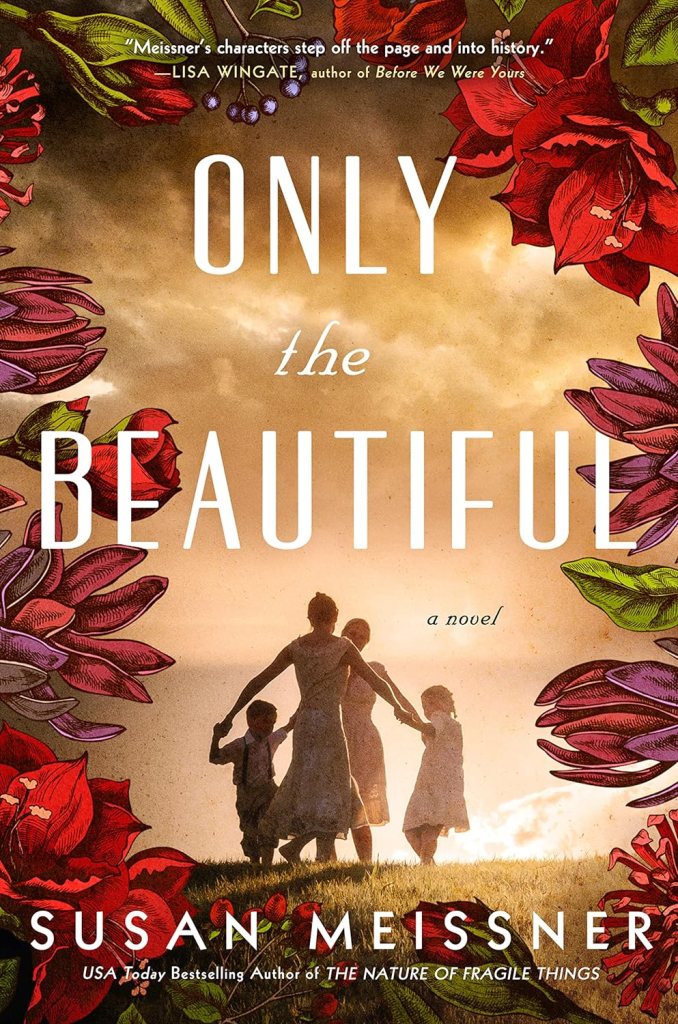
Book Review: Only the Beautiful by Susan Meissner

Amazon Affiliate Link Used Helps to Support this Blog

This touching story begins in 1938 with a teenage girl named Rosie in California who becomes an orphan. Taken in my her parents’ employer, she falls victim to the man of the house and gets pregnant. But Rosie has a secret that made her different, and her secret is betrayed so that she is not sent to a home for unwed mothers but to a mental institution. This thread is intriguing by itself but Meissner links Rosie with a woman, Helen, who works in Europe as a nanny as the Nazis are targeting disabled children. Her heartbreaking experience leads her to do what she can to save as many children as possible. Many years after the war Helen goest back to California and learns that her brother was the father of Rosie’s baby, the only relative Helen has left. Helen had met Rosie when the girl was younger and corresponded with her a few times, But where is Rosie now and what became of her baby?

There are so many lessons we can learn from this story, inspired by the eugenics movement that existed in some places in the US until the 1970s, according to the author’s note, which is not to be missed.

I’m a fan of all of Meissner’s books, but my goodness, this one is exquisite. Highly recommend!

Reviewed by Cindy Thomson, http://www.cindyswriting.com

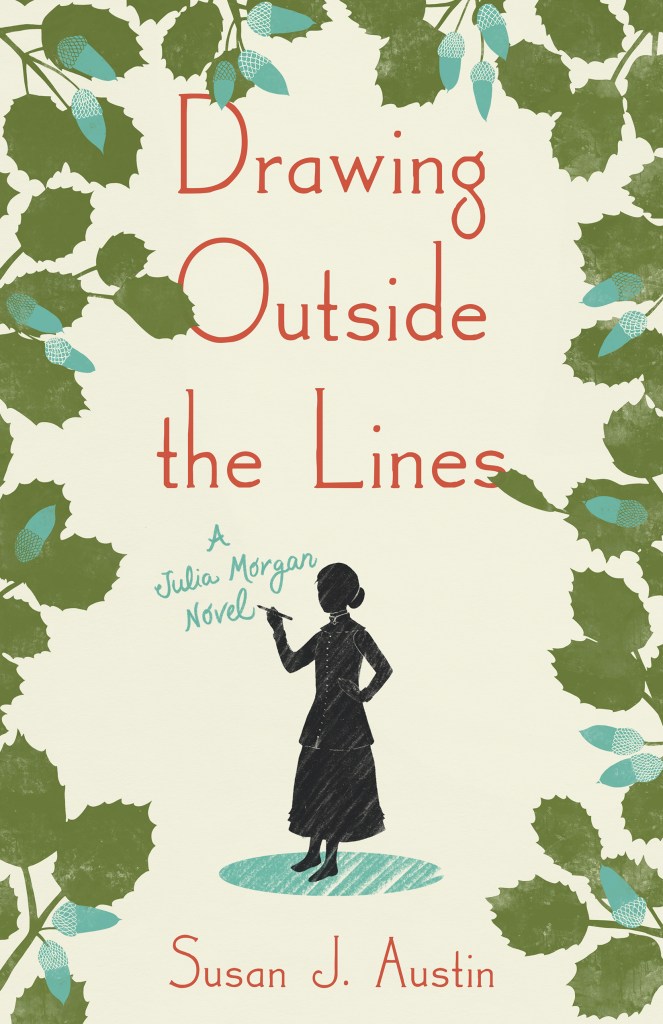
Introducing Julie Morgan from Drawing Outside the Lines by Susan J. Austin

I’m a little surprised you agreed to this interview, Miss Morgan. You have always been reluctant to speak about yourself in public.

That is true. I have always refused interviews. I’ve never sought the limelight. I leave that to others, with egos far greater than mine. However, I think it’s time for me to open that door, even if only a crack. I recognize that by being silent, people may have an inaccurate picture of me, and accuracy matters, don’t you agree? 

Absolutely! Speaking of accuracy, little is known about your early years before you became a legendary architect.  I know you were born in San Francisco, and as a young child your family moved across the bay to Oakland. You attended Oakland public schools before enrolling at the university in Berkeley. What were those years like, growing up in Oakland in the late 1800s’s?

 (JM smiles for the first time, leans back in her chair) Oakland was so beautiful then, and true to its name, oak trees were plentiful, growing in front of houses, on street corners, spreading their green splendor throughout our neighborhoods. Charming Victorian houses lined the streets. Travel was by horse and buggy mostly on dirt roads, as well as on a growing number of paved streets with actual sidewalks which made roller skating so much more fun. The houses in my neighborhood were surrounded by low-set iron or picket fences connecting one to the other. As a child, I preferred the pickets. The narrow wood crossbeams nailed along their backside turned into a raised sidewalk, a perfect fit for small feet. Besides the oaks, there were a few towering Monterey pines that provided another wonderful childhood diversion. A low hanging limb made an easy first step. The rest of the way was like climbing a ladder. I loved being up there, high above the ground. The higher, the better.

Your dream of becoming an architect at a time when the Victorian Era was near its end, must have been challenging? 

Oh my, yes. The expectations for young girls always created problems for me. While I never fit the mold dictated by society, I did manage to avoid drawing too much criticism by staying quiet and respectful. However, there is something you must understand. The realization that I wanted to become an architect developed slowly. I didn’t wake up one morning with a clear picture. It was a gradual unfolding, much like watching a building go up—a little at a time. 

The opportunity to watch the construction of the Brooklyn Bridge was one of those pieces. After 14 long years of dangerous and stunning engineering work, it finally opened to the public in 1883. I had been watching it develop from before I could walk. My mother’s parents, my grandparents, lived within walking distance from this engineering marvel. My family made frequent trips from Oakland to the east coast on the transcontinental train. I was there shortly after the grand opening of the bridge. What a thrill! When I first stood on that bridge beside my architect cousin, Pierre LeBrun, I knew that I wanted to create something extraordinary in my life, I just did not yet know how.

And by the way, during those early years of my life in Oakland, the city was in the midst of a building boom, construction everywhere. In fact, my family built its own magnificent home. I followed that project with great enthusiasm.

Oakland High School played a significant role in your life. Can you tell us something about those years and how they influenced your path to architecture? 

My early school years were easy for me. I was always at the top of my class, but survived being teased by staying quiet, almost invisible. Everything changed in high school, mostly because I chose what was called The Science Track, filled with arrogant boys and a sprinkling of girls. That was where I met Miss Mollie Connors, the school’s memorable and influential drafting teacher. And that was also when the boys began to show their true colors. They had little patience for a girl sitting next to them, especially one who had caught Miss Connor’s eye. What a force! She inspired many future architects.

When you enrolled at the University of California, you majored in engineering. What was behind that unusual choice? 

I had no choice. By that time, I knew I wanted to become an architect, but the program had not yet been established. Even so, both my cousin, Pierre LeBrun and Miss Connors supported my decision to major in engineering They rightly believed that it would give me a sound grounding for my future study of architecture. They were right! Many of my buildings stand today of my buildings’ ability to withstanding earthquake and fire.

What was your college experience like?

College at Berkeley was a mix of experiences. I studied hard, dealt with arrogant male students and antagonistic professors, most who believed that a woman’s place was in the home. The smartest thing I did was join the first sorority on campus, Kappa Alpha Theta, which, by the way, we still refer to as a fraternity. Without these smart, caring, energetic women in my life I probably would have spent all four years in the library buried under my pile of books.

Did your parents support you in this dream?

What an interesting question. Yes and no. The truth is, while my mother was proud of my achievements throughout my lifetime, during those high school years she was deeply worried about how my ambition could disrupt my path to happiness. Most girls and their parents in well-off families had but one dream. To ‘come out’ as a debutante, to be courted by attentive young men, to select one as a mate, and to live happily ever after as a wife and mother. By the time I became of age, I knew my dream was to become an architect. I also knew that having both marriage and a career would never be possible. But of course, I did not use that argument with my mother. Instead, I convinced her to focus her energies on my younger sister, Emma, who was known in the family as the ‘beauty’ while I was considered to be ‘the brain.’  Needless to say, although Mama was devasted, in the end she permitted me following my dream. 

Papa, on the other hand, supported me from the beginning. He and I would frequently visit the construction site of our new home, and he even escorted me to San Francisco to purchase my drafting equipment for high school. I believe he had some experience with deferring dreams. 

You succeeded in achieving the dreams of your youth. Your path was challenging as well as rewarding. As you look back to those early days, what essential elements helped you most?

Two personal attributes paved my way from the beginning—courage and persistence,. These characteristics will always play an important role in achieving one’s dreams, which has been especially true for women.  


As an educator, Susan J. Austin knows the minds of young readers. Her first novel, The Bamboo Garden, is set in Berkeley, California, 1923, and describes an unlikely friendship between two girls that is tested by a fierce fire that threatens to destroy their town. Currently, she is writing about twelve-year-old Goldie, a whiz kid in the kitchen who hopes that her culinary magic can help her family’s delicatessen out of a pickle in 1928 Hollywood. Her characters are always brave, strong willed risk-takers. Writing historical fiction offers her a way to educate and excite her readers about the past. She and her husband live in Northern California, surrounded by family, their splendid but fussy rose bushes, and a lifetime collection of books. Learn more at www.susanjaustin.com.

Meet Richard Stevens from Kathleen Denly’s Sing in the Sunlight

After hearing several interesting rumors about Richard Stevens, I decided to track him down for a few answers. I found him on Montgomery Street.

Good afternoon, Mr. Stevens. I was wondering if I might have a moment of your time to ask a few questions on behalf of our Novel PASTimes readers. 

I was just about to dine at this restaurant. If you don’t mind joining me, I’m happy to answer your questions. Although, I can’t imagine why your readers would be interested in me.

I followed Mr. Stevens into the restaurant and we were seated at a long table beside several other hungry men. It was a bit noisy, but I managed to speak above the din as we waited for our food.

Well, to begin, someone informed me that you have a connection to one of our previous interviewees—a Miss Eliza Brooks. Is that so?

She’s Mrs. Clarke now, but my connection isn’t so much with her as with her husband. We grew up together in Roxbury, Massachusetts.

Did the two of you come to California together? 

No, he came years before I did. Do you mind if I pray before we eat?

Of course not. Go right ahead. 

Richard bowed his head to silently pray before nodding that I could continue.  

I’ve heard rumors of scandals involving your family back east. Something about your father’s drunken temper and your mother falling down a flight of stairs. 

Who told you that? 

It’s true then? Did you come west to get away from your father?

Listen, I agreed to answer your questions about me. Leave my family out of it or this interview is through.

Of course, my apologies. I was just trying to establish your reason for coming to California.

I escorted my sister here, but before you ask, I’m not going to talk about why she came. I stayed because of the opportunities available to me here that I couldn’t find back east. The people here, the life…it’s very different from the parlor visits and society dinners I grew up with. I know I can make a difference here, but…

Stevens’s words trailed off as our food arrived. Once the waiter had gone, I encouraged him to continue.

But what?

Forget it. What’s your next question?

I understand you’re now the owner of the Prosperity Mine in Nevada City. Can you tell me how that came to be?

There was an accident last year that took the previous owner’s son. Mr. Pollack and his wife decided to move back east and sold me the mine. 

Why you? Certainly there were others able to offer a better price for such a valuable enterprise. If you’d been working for them you couldn’t have saved up that much money. Unless you have family money…?

That wasn’t it. Mr. Pollack didn’t trust another investor not to cut corners. He was a good man who cared about the men that worked for him. He knew that, having worked there for two years, I knew what changes were needed to see that another accident didn’t happen. He trusted me to get it done.

That says a lot about you. Tell me, is it true you’ve hired a female as your secretary?

Yes. I encountered Miss Bennetti on a trip to San Francisco a few months ago. She was in need of a job and I was in need of a secretary. She has proven herself to be an excellent employee. I couldn’t be more pleased with her work. 

There are several who think you hired her with ulterior motives. Your miners claim they aren’t allowed to even speak to her because you’re planning to propose marriage to her.

When did you speak with my men? Forget it. Wherever you heard that nonsense, it simply isn’t true. My relationship with Miss Bennetti is strictly professional. In fact, I’ve recently learned she’s formed an attachment with…well, I’d better not say. I’m not sure they’ve made their announcement yet. 

Hmm. If not your secretary, perhaps you’re romantic interests lay with this Miss Johnson you’ve been searching for? I hear you’ve been knocking on doors all over the city. 

I’m afraid you’ve been misinformed again. I’m looking for Fletcher Johnson—a man. 

Hmm. Just a moment while I check my notes. Ah, yes, my apologies. It’s a Mr. Johnson and a Miss Humphrey whom you’ve been asking about. Is she the one—?

I’m sorry. I don’t mean to be rude, but I thought you were going to ask questions about me, maybe about the mine or…I don’t know, what. But so far you’ve insulted my family and continued to poke your nose into topics that are none of your business. I think this interview is through. 

But you didn’t answer—

My food’s getting cold. 

I tried several more times to get Mr. Stevens talking again, but he just kept eating in silence. When he was through, he smiled politely, thanked me for my company, and took his leave.


Kathleen Denly writes historical romance stories to entertain, encourage, and inspire readers toward a better understanding of our amazing God and how He sees us. Award winning author of the Chaparral Hearts series, she also shares history tidbits, thoughts on writing, books reviews and more at KathleenDenly.com.

Social Media Links:

Website | Newsletter | FB Author Page FB Reader Group

 Instagram | Twitter | Goodreads | Pinterest | BookBub | Amazon