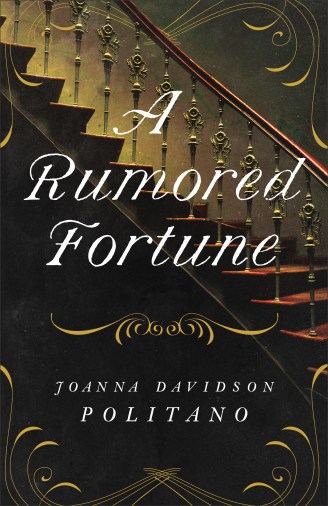
Today we have the pleasure of meeting Tressa Harlowe from Joanna Davidson Politano’s A Rumored Fortune.
 Supposedly there’s a fortune hidden somewhere on your estate. Is it true?
Of course it is. Just because we haven’t found it yet, doesn’t mean it isn’t there. I know my father, and if he claims he has hidden his fortune, then he’s done exactly that. Besides, if there’s no hidden fortune, it means we have nothing.
You say you know your father, but if that’s the case, wouldn’t you know where he’d hide his fortune?
That’s none of your concern. I know the man better than anyone does. Do the women of Her Majesty’s court not know the queen, even from a distance? I know the sort of man my father was, and I know he’d never lie about his great fortune.
How would you describe the man, then?
(After a pause)—He was strong and true and good, the best father a girl could have. I admired him so, and felt a sort of hero worship for him. Such wisdom he had about a great many things. Most of our conversations centered around vines, for his vineyards were the great love of his life. We talked of grapes and branches, but in doing so we talked of deeper things too, without saying the words. He understood vineyards the way physicians understand the human body and accountants understand sums. I never would have cared a whit for vines or grapes except that it was who he was. To love his vineyards was to love him, so these rows of winding branches and vines have become dear to me.
You know, vines are such a mystery. They burst forth with wonderful sweet fruit, but only if the conditions are perfect—pruning, weather, season, protection and drainage. Father was something like that, only the conditions were never right.
There have been a great many visitors to your estate lately. What should happen if one of them were to find the fortune before you?
Let them all search in the nooks and crannies forever, learning the intricacies of Trevelyan. They could spend years looking for the fortune on an estate of this size. In the meantime, I’ll be studying the man who hid the fortune. Understanding my closed-off Father is the key to finding the fortune he hid. I just know the answer is somewhere in his vineyard notebooks, written in some kind of symbolic riddle.
Now that I’ve found someone who speaks Welsh, I’ll be able to translate his notebooks and unlock the pages he poured himself into all these years. I only have to work up the courage to hand the notebooks to that vineyard manager.
The vineyard manager, Donegan Vance. He’s new to the estate, isn’t he? You are brave to trust a newcomer with the secret to your father’s fortune.
I haven’t any choice now, have I? No one else about the place speaks Welsh. Trust is coming slowly where this man is concerned. He may be a bit too forthright and lacking in certain gentlemanly restraint, but his brashness does have one advantage—total honesty. Everything that comes from the man’s mouth is honest to a fault. I don’t have to enjoy the man’s company to believe him trustworthy.
It’s been said you’ve spent a lot of time together, both in the vineyard and out about Welporth. Have you been searching for the treasure together?
He’s become a partner of sorts in the treasure hunt, out of necessity. I will say, though, that from the moment he pounded up the path to Trevelyan on his massive black stallion, he’s been nothing but a rescuer for me. Mother may say what she likes, but the man is a solid rock. He’s bold and opinionated, which truly unsettles me at times, but he’s been a pleasant cool breeze of truth as well. Sometimes I regret partnering with him, but so far he’s proven to be nothing but a help. He seems to have a natural wisdom about vineyards too, and the deeper meaning behind the way the plants work.
He said something to me once about the Scripture passage, “speaking the truth in love.” I think perhaps he can teach me a bit about that, and maybe I can help him with the rest—speaking the truth in love. That’s the way I think of our partnership right now—opposites that work well together. If it weren’t for the secret I see shadowed in his eyes, perhaps I could trust him completely and tell him everything I know, but with the way things are going now, there’s not a single person among my acquaintances I’d trust to that extent.
What of Andrew, your fiancé? One would assume you could trust him.
First of all he’s no longer my fiancé. That courtship died a painful death over a year ago when his parents pressured him to end our association. Yes, he’s come to stay at Trevelyan, but it doesn’t mean anything. Mother convinced him to come help us grieve Father’s passing, and I wish he’d simply take himself home again. I cannot bear to see the face of my deepest rejection every day in my own house. I want to trust him, to seek his help with this fortune hunt, but after all that’s happened between us, I simply cannot trust the man. I suppose the only one a person can trust is God.
Are you a very religious person?
I suppose I am. I’ve attended church since birth and I’ve always felt a peace there. I believe there’s something more to it, though. Don’t think me mad, but sometimes I feel as if God tries to connect directly to me, even outside of a sermon. It happens when I paint. Ever since I was small, I’d sink into this creative outlet and at the same time sink into conversation with God. I let my thoughts flow free and unhindered with each sweep of my brush. Life splashed through my soul as color splashed over white canvas. I always thought it was because I had no one else I connected deeply with, and it was my imaginative, artistic heart’s invention.
Lately it seems He’s been trying to reach me again, though, and it’s always through color, through artwork. From the orangey glow of dawn on morning fog to the sunlight shining through stained glass, color seems to be His specific way of reaching me. It’s as if He’s speaking my language to ensure His words sink directly and deeply into my heart. Perhaps it’s only the wishful thinking of a little girl who has grown up around the hole my earthly father left in my heart. I cannot deny, however, the taste I’ve had of life and the hope I’ve felt.
Thank you for visiting with us today, Tressa. We hope you find your treasure!
 Joanna Davidson Politano is the award-winning author of Lady Jayne Disappears. She freelances for a small nonfiction publisher but spends much of her time spinning tales that capture the colorful, exquisite details in ordinary lives. She is always on the hunt for random acts of kindness, people willing to share their deepest secrets with a stranger, and hidden stashes of sweets. She lives with her husband and their two babies in a house in the woods near Lake Michigan and shares stories that move her at www.jdpstories.com.
Facebook: www.facebook.com/joannadavidsonpolitano/
Twitter: https://twitter.com/politano_joanna
Pinterest: https://www.pinterest.com/sunshine39n/
 Today we welcome Em, a character from The Hope of Azure Springs by Rachel Fordham.
 Rachel Fordham started writing when her children began begging her for stories at night. She’d pull a book from the shelf, but they’d insist she make one up. Finally she paired her love of good stories with her love of writing, and she hasn’t stopped since. She lives with her husband and children on an island in the state of Washington.
 Valerie Fraser Luesse is an award-winning magazine writer best known for her feature stories and essays in Southern Living, where she is currently a senior travel editor. Her work has been anthologized in the audio collection Southern Voices and in A Glimpse of Heaven, an essay collection featuring works by C. S. Lewis, Randy Alcorn, John Wesley, and others. As a freelance writer and editor, she was the lead writer for Southern Living 50 Years: A Celebration of People, Places, and Culture. Specializing in stories about unique pockets of Southern culture, Luesse has published major pieces on the Gulf Coast, the Mississippi Delta, Louisiana’s Acadian Prairie, and the Outer Banks of North Carolina. Her editorial section on Hurricane Katrina recovery in Mississippi and Louisiana won the 2009 Writer of the Year award from the Southeast Tourism Society.

 I write Christian Historical Western Romance. Yes, that often entails the use of firearms in a threatening manner. Sometimes there are fistfights. There may even be politically incorrect but historically accurate language. But also, there is always an inspirational message and strong allusions (at least) to the gospel. A former journalist, I am an avid researcher and endeavor to skillfully weave truth in among fictional story lines. I love exploring the American West, especially ghost towns and museums. I have walked parts of the Oregon Trail, ridden horses through the Rockies, climbed to the top of Independence Rock, and even held an outlaw’s note in my hand. I grew up in the mountains of Western North Carolina on a steady diet of Bonanza, Gunsmoke, and John Wayne Westerns. My most fond childhood memory is of sitting next to my daddy, munching on popcorn, and watching Lucas McCain unload that Winchester! My daddy also taught me to shoot and, trust me, I can sew buttons on with my rifle.
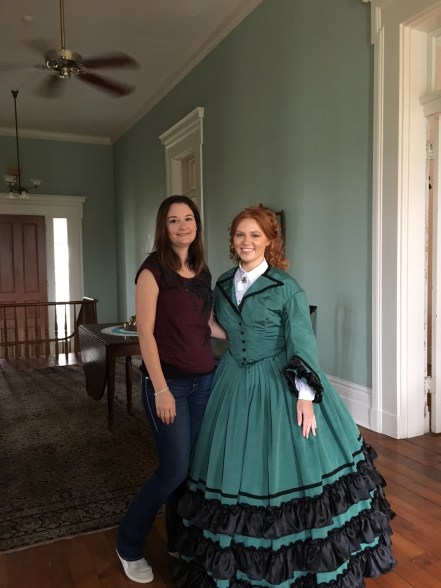


 Linda Shenton Matchett is an author, journalist, speaker, and history geek. Born in Baltimore, Maryland, a stone’s throw from Fort McHenry, Linda has lived in historical places most of her life. She is a volunteer docent at the Wright Museum of WWII and a Trustee for the Wolfeboro Public Library. Active in her church, Linda serves as treasurer, usher, choir member, and Bible study leader.
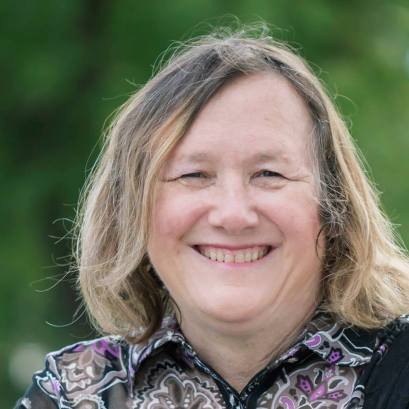 Ellen Porter is a former journalist and the author of The Red Hawk, which is a fictionalized look at the historical events impacting the first settlers of her hometown, Chowchilla, California. The first settlers are some of the Native Americans whose tribe now shares a name with her hometown, but long ago used a different spelling, possibly Chaushilha as she spells it in her book. Ellen wrote this book as the first in a series to honor the memory of Reddy Redskin, a legendary character who served as Chowchilla High School’s mascot from 1916 when the school first opened until 2016, when the school was forced to abandon the mascot under 2015 legislation. Ellen began writing The Red Hawk a few days after the legislation was approved by the governor.
 Originally known for applying his creative vision to the composition of Christian art-rock epics, Bartholomew Boge has found a new niche writing historical fiction. Whether it be through music or literature, Bartholomew challenges his audience to examine the depravity of man and the redeeming grace of God, bought with the shed blood of Christ.
 Novel PASTimes