
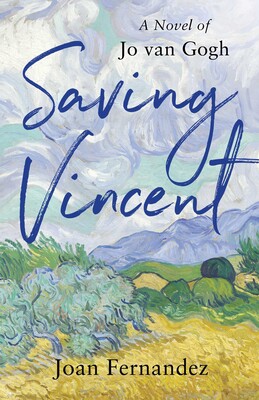
ABOUT THE BOOK:
How did a failed belligerent Dutch painter become one of the greatest artists of our time?
In 1891, timid Jo van Gogh Bonger lives safely in the background of her art dealer husband Theo’s passion for selling the work of unknown artists, especially his ill-fated dead brother, Vincent. When Theo dies unexpectedly, Jo’s brief happiness is shattered. Her inheritance—hundreds of unsold paintings by Vincent—is worthless. Pressured to move to her parents’ home, Jo defies tradition, instead choosing to open a boarding house, raise her infant son alone, and promote Vincent’s art herself. Her ingenuity and persistence draw the powerful opposition of a Parisian art dealer who vows to prevent her success, and so sink Vincent into obscurity. How will Jo overcome the forces working against her, and save herself along with Vincent?
In the spring of 1894, a young Parisian—an aspiring newspaperman —pauses at the doorstep of the Dutch widow’s guesthouse. By chance, he’d become stranded in the town, for he’d miscalculated the amount of time the train would stop in the Bussum station and gotten off to stretch his legs, only to find himself running behind the disappearing caboose not fifteen minutes later. Now stuck in this backwater village, he’d asked the stationmaster for a place to lodge. “Try the widow Johanna van Gogh,” he’d said, pointing down a dirt road adding, “The art dealer.” A woman art dealer!What luck! It was just the type of curiosity he could sell. He bounds up the steps and raps sharply on her door.
But thirty minutes later, he’s sitting on Mevrouw van Gogh’s sofa more bewildered than ever. This is not the grey-haired widow he’d imagined. She hands him a steaming cup of hot tea and takes a seat in a large stuffed chair opposite him.
Jo: All right then. I have just a few minutes before supper preparation. Tell me what you want to know.
Newsman: Well, for starters, the artwork you have hanging all over your house is stunning. Gauguin, Degas, Lautrec and of course, your brother-in-law Van Gogh. . .It’s like a museum! But tell me, why here? Bussum is such an out-of-the-way little Dutch town. Surely cities like Rotterdam or The Hague would be better?
Jo: I don’t think so. I know cities. I grew up in Amsterdam and lived in Paris for nearly two years when my husband Theo was alive. Art dealing is like a street fight there. There are so many dealers and hundreds, if not thousands, of aspiring artists. Competition is cutthroat.
Newsman: You have art collectors in Bussum?
Jo: Not many.
Newsman: Then how can you make money as an art dealer here?
Jo: Well, first of all, my guesthouse earnings literally keep a roof over me and my son’s head. I need independent income. After Theo died, my father assumed I’d move back home, but I couldn’t. I’m no longer a frightened little rabbit. Marriage to Theo changed me. He listened to my ideas. We shared both our dreams and worries. I never dreamed that a marriage could be like that. A partnership. My father doesn’t understand.
Newsman: Did Theo train you to become an art dealer?
Jo: Not. . . intentionally. He was sick but it never occurred to either of us he would die. When I found out that the inheritance my son and I share was all of Vincent’s artwork—we’re talking hundreds of paintings and drawings—I needed to see if it could all amount to something.
Newsman: What do you mean?
Jo: Theo was only ever able to sell a handful of Vincent’s paintings. Most art critics panned Vincent. His paintings were nearly worthless.
Newsman: But what made you think you could sell the paintings when your husband couldn’t?
Jo: I would never compare myself to Theo!
Newsman: If anything, I think it would be more difficult. Art dealing is a man’s occupation. You said yourself that it’s cutthroat.
Jo: I’m persistent. I write letters to Dutch galleries asking them to display Vincent’s work. I’ve given art to influential friends who then loan them back to me for exhibits. When I add a little note in the catalog that the work is owned by a private collector, patrons tend to give the art a second look. It’s gotten to the point that dealers are starting to contact me to see if they can sell Vincent’s work. Paintings are being crated and shipped every week. I have so many lists! It’s a lot to keep track of.
Newsman: Is that why I smelt wood shavings when I came in?
Jo: Oh dear (laughter). When the weather’s bad we hammer the crates here in the salon. The broom can’t seem to get all the wood slivers.
Newsman: Are your efforts working?
Jo: Do you mean am I persuasive? I actually sold more paintings in my first year than Theo did in the ten years he supported Vincent.
Newsman: I wouldn’t expect that from a woman!
Jo: (smiling) Most people don’t. Let me tell you what I think my best idea’s been so far to attract interest to Vincent’s work. In 1893 Theo and Vincent’s good friend, Émile Bernard, approached the editor of Le Mercure de France to do an article about Vincent.
Newsman: Mercure the Parisian art journal?
Jo: That’s the one. When the editor agreed, I sent him not only drawings, but translated excerpts from letters Vincent wrote to Theo. They’re a treasure trove! Witty, angry, frustrated and most of all, so passionate about trying to produce art his own way. I came to know Vincent myself through those letters, for I only met him three times in person. Theo was a packrat. He kept all of their correspondence. It wasn’t until a year after his death that I began to read the letters he’d crammed into the nooks and crannies of his writing desk. So, for Mercure, I chose excerpts that would spark the public’s curiosity—and they did. Instead of one article, the editor increased the plan to six.
Newsman: I’m astounded at your pride! Women are meant to be mothers, not to be in commerce.
Jo: Come now! I am a mother. I’ve been raising my son on my own since he was a baby. He’s four years old now. I want him to know his father left him a legacy of value and that neither his uncle nor his father worked in vain. I didn’t realize it until a friend pointed it out to me, but I’m what they call a “New Woman.” A woman capable of many things outside of traditional female occupations. I’ve changed a lot from that frightened rabbit. I think that’s progress, and it’s the perfect role model for my son.
Newsman: I beg your pardon, but it’s not quite adding up. You’ve been at this for nearly three years. Vincent van Gogh’s art is too controversial to ever catch on. Why haven’t you given up?
Jo: Vincent. I think I understand him.
Newsman: What do you mean?
Jo: (looking down at the clasped hands in her lap) When I came to Holland—completely sure in myself about the great—the indescribable height of that solitary artist life—what I felt then, faced with the indifference that met me on all sides where Vincent and his work was concerned—the burning sense of the whole world against him—I felt so abandoned—that I understood for the first time what he must have felt—in those times where everyone turned against him and it was as if there was no place for him on earth. I wish you could feel what Vincent’s influence on my life has been. I’m grateful to him. . . (Looking up she smiles and quickly swipes at a tear). Now, do you have enough? My guest Mevrouw van Dijk becomes quite grumpy if supper is late!
Newsman: Yes, plenty. Thank you, Mevrouw van Gogh. I’m honored. . .
Jo: You’re most welcome.
“Lovers of Van Gogh will find this story intense, vibrant and deeply moving.” Based on a true story, Jo van Gogh, a timid widow, takes on the male-dominated art elite to save her brother-in-law Vincent’s art from obscurity. She must prove that the hundreds of worthless paintings she inherited are world-class to ensure her young son will have an inheritance.

In 2018, Joan Fernandez retired from a 30+ year career as a senior marketing executive to be a full-time writer. Her short story, “A Parisian Daughter,” is published in the anthology, Feisty Deeds: Historical Fictions of Daring Women. Her debut novel, Saving Vincent, A Novel of Jo van Gogh, will be published in April 2025 by She Writes Press. Joan is a sought-after public speaker, reviewer and blogger. She calls both St. Louis and Sedona, Arizona, home, and enjoys foodie meals with her Cuban husband and antics with grandkids. Subscribe to her free newsletter at joanfernandez.substack.com Follow her at @joanfernandezauthor and see her website at www.joanfernandezauthor.com
 Novel PASTimes